Ben In Ghana has moved!

And transformed into The Borrowed Bicycle. You should be automatically redirected in 6 seconds. If not, visit
http://theborrowedbicycle.ca/
and update your bookmarks. Thanks for helping make this as painless a transition as possible!

Wednesday, August 04, 2010

Good Enough

I would be lying if I didn't say that the past five months have been a struggle for me. In many ways this blog has been a reflection of those challenges. I'm not sure how noticeable it has been for others, but one thing I've struggled with, and struggled to write about is the actual work I'm supposed to be doing here. I have a great family life where I learn something new every day, and I'm having a lot of fun sharing that with people. Work has been a different story.

My commute is almost a passage between worlds. The freedom of the road turns quickly transitions to the stagnation of my seat behind my computer at my desk. I've had a lot of trouble getting out of this mode. Things move pretty slow here in general, but by the end of a day I often feel stuck. Some days I know I'm not bringing what it takes to move things along in a district and I wonder if maybe this isn't the place for me. And most days that all melts away again with those fifteen kilometers of asphalt and wind in my hair that lead back to Seripe.

One of the reasons I've struggled is insisting on perfection before I start implementing. It has been easy for me think of ways things will fail, why they aren't perfect and to delay pushing forward based on that. I'm learning that I won't be able to get very far if I keep up that strategy. Instead of perfection I need to do a better job of recognizing 'good enough', at least for the first implementation of an idea. There are a lot of roadblocks in development, and I need to admit that I'll never be smart enough to think my way through them.

The same goes for my blog. Thank you all so much for the extremely positive feedback you've given me on my first few posts – I really enjoy writing and putting something together that makes people think. That said, I've found myself looking for ways to one-up myself. I want every post to be the new 'best' post. Unfortunately this isn't exactly a sustainable solution, nor does it work well for anyone reading – I'm certainly writing less and posting even less than that!

At the end of the day I still want to create excellent work. I don't want the pendulum to swing too far to the side of poorly thought out ideas that I'm rushing to implement for quantitative numbers of prototypes created, or pieces posted on this blog. I see enough of that here to know it isn't the way forward either.

I hope this post is a start along that path – it certainly isn't my best post, but as I read it over I think it qualifies as 'good enough', something I'm happy with. I'm not sure I'm 100% satisfied with the ending, but that's ok. I've been applying that lens to all of my work over the past week or so and my motivation has been going up, I'm feeling busier, more productive, and happier to be at work. And based on that, expect to see a lot more 'good enough' from me in the future.

Monday, July 26, 2010

This Week on the Farm - Episode 2

Hey Everyone!

Thank you so much for all of the great feedback from last week's video. It was definitely a boost to my week!

And no, I don't just do that Ghanaian accent for fun. I remember giving a fairly good closing remark (I thought at least) to a workshop only to be met by a circle of blank stares and unenthusiastic claps when I finished. I asked my boss why and she told me - "Everyone thinks you're very nice - they just can't understand anything you say!" Dery's a bit deaf in the left ear which only compounds the problem. Hence, the thick (da tick) Ghanaian accent.

Episode 2 is now here - delayed due to very slow Internet on Friday. You can watch it http://www.youtube.com/watch?v=wWSyH1xSoLc or below!

Also, if anyone is interested in sending a video message or asking some questions that I can share with Dery and the rest of the family they would be very appreciative. He's interested in what is going on in Canada as well!

Thanks!

Friday, July 16, 2010

This Week on the Farm - Video Blog

Hey Everyone,

After a long hiatus I'm excited to announce a series of videos about life on the farm in Seripe. I'll be filming a few short clips each week and uploading them to youtube (yes it's possible, it just takes about a day).

You'll have to bear with me - the first episode was completely impromptu and my video editing skills are poor, but I hope you enjoy it! Check it out at http://www.youtube.com/watch?v=HAr6ZXsoIH0 or below.

Also, if you have any questions or suggestions of things to film for an episode, I'm taking requests! This episode doesn't do a very good job of introducing Dery, the farmer I'm staying with, so I'll work on a quick intro piece so you get to know him and a bit about where he's at.

I also took off to Tamale for a week of team meetings and left the camera with Dery, so expect an episode about ploughing as soon as I can get the editing done.

Thanks for reading/watching!

Saturday, May 29, 2010

Seripe

After a few weeks of arrangements I've moved into the village of Seripe, just over 15km from Bole, south on the main road. I live with the a farmer named Dery Torwel along with his wife, his three daughters Anita, Winnie and Amelia, and Anita's son Vitalis. Two of his sons, Philip and Matthew, are attending school in the Upper West and his third son Sulupule lives with his wife in Sunyani, a city in the Brong-Ahafo region, a few hours south. The compound is about a ten minute walk from the road and the borehole, and Dery's brother's compound is just next to his.


As the rains begin to fall, the area between compounds is growing green. The stars are fantastic. Leo is spread out across the top of the sky; the familiar Big Dipper is in the north and the brilliant Southern Cross opposite it. Women walk gracefully with wood or water on their heads; they laugh at my greetings in Dagarre, the local language, not worrying for a second about spilling a drop. Amelia and her cousins dance and sing in the open space just outside of the compound door. Dery and I have conversations into the darkness about life in Canada and Ghana, often punctuated by his very Ghanaian expression of surprise, “So!” People are constantly dropping in to the compound to say hi and chat, to test my Dagarre and hopefully be the one to teach me a new phrase. In short, the place and the people have been easy to fall in love with.


It's easy to see life in an African village as romantic – and it certainly can be, especially as an Westerner. I remember having a conversation with some of my fellow volunteers into 2006, all of us wondering if we had seen “real” poverty yet. Life in Ghana as I've experienced it isn't a World Vision commercial, and it is easy to wonder if Amelia's smiling face is really that of “real” poverty. Shouldn't poverty have a face that is miserable and destitute?

This illusion has been broken for me several times over the past few weeks in ways that it hadn't been before. The day I arrived in Seripe, a man died in his house two weeks after stomach surgery. After his death I learned I had met him the week before – he was a member of one of the farmer groups and good friends with the Agric Extension Agent. I remember walking down the path to his house, but hard as I try, I can't recall his face. A week after I arrived, Dery fell off the back of a motorbike. Even though it wasn't going fast he dislocated two of his toes and hit his knee. He wasn't able to farm for a month, and the fact that the rains are late so far this year is both a blessing and a curse. He is struggling to find labourers to help clear five acres of land for a maize field in time to plough; gold was recently discovered nearby Seripe and many of the young men who used to be available as labour for hire now mine illegally instead. Philip used to attend school in Seripe but the quality of education is poor and so Dery now pays to send him and Matthew to the Upper West, losing two much needed weekend farm hands.


More than ever, life in Seripe has shown me that poverty isn't something you can always see on the surface. I have certainly been one of those guilty of expecting that it should be. Instead it's something much more complex, much more difficult to articulate. The lack of opportunity, the vulnerabilities to shocks and stresses, the lack of access to or trust in basic services like health and education, poorly functioning markets and dependence on the weather. I have seen all of these factors at play in Seripe, but I haven't seen abject misery. The past month has been a sharp reminder that Dery's strong, proud smile as he stands with his family can still be the smile of poverty.


Picture Legend from top (and apologies as I still struggle to get pictures put into exactly the right spot!):

  1. Anita and Winnie, Dery's two oldest daughters
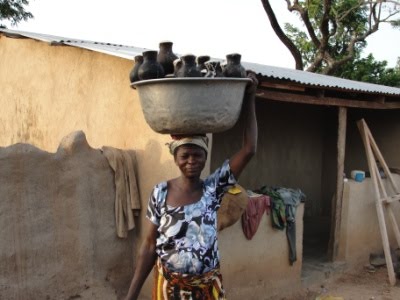
  2. Dery's wife carrying pito (the local drink, brewed from sorghum) to the market
  3. Dery, his sister and two of his sons, Philip and Matthew
  4. A view over the compound wall
  5. Amelia, Dery's youngest daughter
  6. Vitalis, Anita's son
  7. My usual sleeping place when it isn't raining (plus mosquito net).
  8. Freshly brewed pito, before heading to the market
  9. Dery

Tuesday, April 06, 2010

Two Days on A Farm (or Why It's Hard to Be an Innovative Farmer)

When you're from the city, two days on a farm can teach you a lot. I'm working in Ghana for the Ministry of Food and Agriculture but man do I have a lot to learn about farming. Two weeks ago I spent two days in Blema, a small village between Sawla and Tuna in the Sawla-Tuna-Kalba district of Northern Ghana. A good friend of mine, Troy Barrie, dropped me off on a Wednesday morning and took off on his moto, promising to return by the same time Friday.

I had the privilege of staying with a farmer named Musah who is doing some pretty incredible things in Blema. Here is a quick run down of the activities he was undertaking during the dry season, when most farmers take a break in preparation for the busy rainy season:
  • Palm nut cultivation (harvesting and nursing seedlings)
  • Mango grafting and cultivation
  • Orange grafting
  • Cashew cultivation
  • Irrigated tomato and garden egg (eggplant) cultivation
  • Animal husbandry (cattle, sheep, goats, chickens, guinea fowl)
  • Training bullocks

Needless to say I learned a lot of practicals about farming over the two days. During the rainy season he'll add the traditional staple farming activities and also grow maize, rice, yam and cassava; in two months it will be another whole world of learning for me! What was more important to me about the two days though, was not what it taught me about farming, but rather about farmers.

Besides being an insanely hard worker, Musah is an innovator and an experimenter. Farmers don't have a lot of insulation from risk here, and even common farming activities such as growing maize and yams are highly dependent on external factors, most notably rain. To invest in new, unproven activities when your family's livelihood is at stake takes a lot of foresight and guts.

The most obvious example of Musah's experiments is his palm nut plantation. To the best of Troy's knowledge, Musah is the only farmer growing palm nut in the entire district – it is much more common in the south where the ground is softer allowing the tree's roots to grow strong and deep. Musah has some land around a stream that floods regularly during the rainy season and decided to test out some palm nut trees. Now, five years later, he has a flourishing palm nut plantation. He has continued to experiment in different places and has another plot of land where the test trees he planted three years ago have started bearing fruit. He plans to fill in the area with palm nut seedlings this year.

Another example of Musah's innovation is his grafting. He learned how to graft mangoes, combining local mangoes with varieties of mangoes that produce bigger fruits. Grafted mangoes are common in Ghana and at first this didn't especially set him apart in my mind. Then we came across a mango tree that had several grafts, six in total. Each graft was a different variety, so this tree will grow up to bear six different types of fruits, and Musah will learn which type does best.

All of this without any formal education. Musah doesn't speak a word of English – his son Alhassan translated for me as we went around the farm. Pretty incredible.

Innovation is something we like to talk a lot about in EWB and at Waterloo. When I think of innovation I think of fast-moving exciting projects, pushing the boundaries and learning quickly. I think of shortening feedback cycles, “failing fast” and constant iteration. Two days with Musah taught me that innovation in farming is a bit different. Watching him meticulously check each of his palm nut trees and grafted mangoes showed me another type of innovation. Innovation where you invest in a seedling and wait three years (three years!!!) before you reap any rewards, before you learn if your experiment worked. This innovation requires patience, doing the small things each and every day with the hope that it might pay off in the end.

In many ways all farmers face this challenge of evaluating short-term decisions against long-term outcomes, even with their regular year-to-year crops. Will the rains come early or late? Is it worth it to invest in fertilizer, herbicide or pesticide? At the end of the day, what will all of this work be worth for me? All of these questions are ambiguous in farming. Sometimes it doesn't pay off at all. I recently met a farmer group in Bole trying to do dry season vegetable gardening. They have several gardens of tomatoes that have just started flowering. Unfortunately, the wells they have been using to irrigate are drying up early this year, along with the tomatoes.

All of this adds to my respect and admiration for what Musah is doing is Blema. Being an innovative farmer is hard. Not only do you have to work hard, you need to be willing to experiment, to take risks, and to be patient.

If you've made it this far, you might be wondering, what does all this mean for EWB's work with the Ministry of Food and Agriculture and with farmers? In order to keep this from becoming another one of my excessively long posts, I'll defer that question, as it's a big one. Stay tuned, that post is on its way!

PS Below are some more pictures from the two days. Hope you enjoy!


Musah stands proudly in front of his palm nut plantation.


Musah's son Alhassan holds a palm nut seedling in the nursery.

Palm nuts! They become more red as the mature before they're ready to be harvested.


Young cashews before the fruit develops.


Alhassan shows the different types of cashew fruits.


Mature cashews ready to be bagged and sold to a processor.


Taking the bullocks to the dam to fetch water.


Look familiar? A soka (or treadle) pump. One of the technologies EWB used to promote in Southern Africa. They use this for irrigation when they don't have money for fuel for the gas pump.


Alright, fine, a picture of me... if I have to. Alhassan to my right and Musah to my left.

Friday, March 19, 2010

One Thousand Two Hundred Eighty-Eight

One Thousand Two Hundred Eighty-Eight. The number of days between leaving Ghana in 2006 and arriving in 2010. In some ways it feels like I never left. It was almost deja vu, leaving Toronto, boarding the plane to Amsterdam, spending way too much on a croissant on the layover before finally landing in the heat, humidity and darkness of Accra. After making it through customs I took a taxi with the three other EWB staff arriving with me to Madam Adisa's house, the last place I stayed in Accra before leaving last time. Adisa greeted us with her usual openness and hospitality – and a large meal of boiled yams and jollof rice. A welcome back that made it feel like I was returning to a place I knew.

I just looked back on my first month of blog posts from 2006 and it has been an interesting reflection. I managed to write about 5000 words describing my first three days or so. I can't say I'd be able to do the same this time around – the sights and sounds that were so new and exciting three years ago seem almost familiar (although the public toilets are still less than appealing and my first bowl of TZ didn't go down quite as easy as I'd hoped).

At the same time I've had the pleasure of watching Reynaldo, a new friend from my training group, go through all of those new experiences. Sitting in the back of a taxi while the driver and the person in the front seat argue at full volume in another language, learning to eat an orange like a Ghanaian, trying to get red dirt out of a white shirt. Venturing into the market is a great metaphor for the whole experience; it is colourful, dirty, crowded, loud, full of smells (good and bad) and almost certainly overwhelming. How much should things cost? Is that person yelling at me or just yelling? Am I in the way? At some point you learn to accept the chaos as normal and go on about your day as if it is.

The two of us were walking with some of the other EWB staff just by the market when Reynaldo asked a simple question. “What is that???”It was a white vehicle with its doors wide open, full of butchered cows. Halves of cows were strewn about the inside next to two cardboard boxes holding piles of folds that jiggled with the sputtering diesel engine. Upon closer inspection the consensus was that is was beef hide, something I had eaten once before. The smell of the meat made the lack of refrigeration conspicuous, just as the loud buzzing made obvious the abundance of flies. As it pulled away two simple words written in large red block letters gave Reynaldo his answer. Meat Van.

I'm sure if I'd seen such a thing on my third day in Ghana in 2006 I would have written an essay on it, but this time it hardly seemed out of the ordinary, and certainly not a shocking discovery. Later, I was sitting listening to the woman who had just cooked us some fried egg sandwiches talk about how she was expecting it to take her three years to save up the 600 GHC (or $480) to buy a container for her tailoring business when a green SUV pulled up with spotless chrome rims and the logo of an NGO painted on the door. Across the street a monkey is chained to the wall. I start to wonder what out of anything in this city should be normal. It reminds me of a story that Tahidu, my old boss and host father once told me. He spoke of an educated teacher that moved to the remote community he was assigned to, determined to do a better job by being closer, missing less of days of work and spending more time on his community. It didn't help, as the teacher became just like the community and nothing changed.

You have to adapt and learn to survive and be happy in another culture, but how far do you go? What do you stay grounded in when so many of your assumptions about what is right are challenged? I've been struggling with this question and wondering if I have too easily accepted the realities of Ghana as normal. What values do I hold on to in order to be an effective catalyst of change? It is hard enough to make change and push boundaries in your own culture, never mind the complications of being a Canadian in Ghana.

Although this question has been especially apparent to me over the past couple of weeks it is not new; it's certainly one I thought about in 2006 and since then. These are the challenges I have been looking forward to coming back to and tackling again, with a little more time and a little more depth. It's a reminder that after one thousand two hundred and eighty-eight days I'm not just coming back to familiar people, places and sensations, but familiar challenges and unanswered questions as well.

Friday, August 04, 2006

Some Thoughts and Learnings

Just thought I’d write down a couple of my current thoughts on development and my experience here in order to get some comments/discussion happening.

I’ve had a couple of interesting discussions about the West’s role in development in Africa and whether or not Westerners should even be coming to Africa at all. My thoughts on this are still pretty scattered, but hopefully writing them down will articulate them a little bit better.

The first thing that I have come to realize is that (nearly) all of the best development work is being done by Ghanaians for Ghanaians. Almost all of the NGOs that EWB works with are indigenous to the country for that very reason. The work that these NGOs do never makes the news in the West, and I wonder if it ever will. News about Africa generally consists of war, conflict, new democracies (with focus on how fragile these new democracies are) and finally successes of Western led NGOs or multilaterals. The real work, the real successes and the real strength that this country has doesn’t make the news.

Another huge misconception that I’ve found is that all Africans want to get an education so they can move to the West. I (and other volunteers that I’ve talked to about this) was very surprised to learn that this is not at all true. I’m sure the view is so widespread because most people that one might meet in Canada from a developing nation has gotten an education and moved away. Even talking to several youth about getting educations in the West, none of them expressed much desire to stay after they had completed. One of my favourite answers was, “Why would I get an education and then use it in some place that is already developed?” I met another young man who actually did his masters in geography at Waterloo. He said his wife eventually convinced him to fly her to Canada and after a week she was ready to go home. “You think I’m enjoying Canada, but now you see how I have been suffering these past years,” was his reply to her. Just the other night I met a man who had spent seven years in the US, and is now back in Ghana because he likes it here better. I’m sure another huge reason for this horribly misplaced belief is that we in the West believe that we’re better, so why wouldn’t someone move here if they had the chance? I’ll take this chance to make this blog a little more controversial and ask you to think about your views on African migration to the West and what assumptions you might be making that are completely unjustified.

Next up, I’ve seen some of the problems caused by charity, which often has its origins in the West. The commitment level of one of the communities involved in the agro forestry project that I am working on in Kukpehi is a perfect example of this. We are now in the planting stage, and each community was to collect their allotment of seedlings from the nursery at Kukpehi before the date they had given for us to start their planting. While most of the communities had collected their seedlings, brought them to the planting site and had a large number of people helping, from children to some of the older adults, this community was nowhere near that level. We arrived at the community and we were told that they were having a meeting, and should return in about an hour. We did an errand that was planned for after the planting, and returned to about four people with only about half of the seedlings collected from Kukpehi. To give you a bit of a reference point, one of the communities we had visited the previous day had about 20 adults and at least 10 children helping us. Another community had already started planting before we arrived. The numbers slowly increased as the work went on, but not to the same level as anywhere else.

After returning to the office, we were talking about this commitment problem, and Adisa gave her explanation. She said that someone dug a large dam for their community without their involvement, and now they’ve come to expect that things should come to them instead of them working towards development in their community. This was emphasized by one of my co-workers comments that they were even asking for us to bring food next time we came! They said the government had come to help them plant their teak woodlot and had brought them food for doing the work. This is why Adisa refuses to work with programs such as the World Food Program and Food for Work. Programs like this make people believe that handouts will continue and they expect to be compensated for doing work to better their own community! This type of attitude is destructive in terms of community-driven development and completely contradicts Africa 2000’s and IPRP’s approaches.

So, where am I actually going with these points? I swear there’s some sort of coherence between them in my head, which I’ll try to get out here. For me, they’re all huge contributors to one of the questions I’ve been asking myself a lot lately: “Sure, what I’ve learned here is going to be beneficial for me and my community back in Canada, but is my placement actually good for Ghana?” This might seem like a ridiculous question at first, the obvious answer is of course it’s good, and judging by the amount of comments I get back from people about the great and amazing work I’m doing here that would be the widespread answer from all of you. I’m sorry if I’m sounding a little bit cynical here, I’m not trying to directly offend or accuse anyone with that last statement, I just feel like none of my blogs have really expressed some of the frustrations, difficulties and tough questions that come along with development.

Three topics I discussed above all have direct bearing on whether or not I am contributing, useful, or maybe harmful to the people of Ghana. My first two points were to illustrate that capacity needed to do good development work is already here. The NGOs that do great work are doing great work, and are staffed by excellent, educated Ghanaians. There are also Ghanaians who graduate every year from Ghanaian universities with development-related degrees who can’t find work. For example, we have a staff member right now doing what is called National Service. Every graduate must do a year’s work towards developing the country before finding their own job in the field of their choice. My director has commented a couple of times that she wishes she could hire him once his national service is up, but doesn’t have the budget for it. Meanwhile, she’s just received two United Nation’s Volunteers and will most likely get at least one National Service person in the fall.

In light of the previous discussion of the problems with giving things away and the expectations created in the future, I have some questions about the effect that I’m having here as a free volunteer for Africa 2000 and IPRP. If at the end of my placement it is decided that I’ve added value to A2N/IPRP and had some impact, will my director begin to expect that she can use EWB volunteers, and stop looking for Ghanaians, who might have to be paid, to play that role in the future?

I recently talked to Louis about these questions and got his answer as to why EWB is not taking Ghanaian jobs. Louis had value-added points that EWB volunteers bring the average NGO staff member in Ghana doesn’t bring.

Pro-poor approach: This might seem like something that anyone working for an NGO here would have, but it is certainly not the case. Development is an industry here, and to many people, working at an NGO is just a job. I feel like my office does not have this problem so much, but hearing the frustrations of other volunteers certainly confirms this. EWB volunteers’ livelihoods do not depend on meeting donors’ needs in order to keep funding or receive new funding. Sadly, these donor requirements don’t always make the poor the number one priority. EWB volunteers can push for pro-poor practices and policies whenever possible, and hopefully have impact in this way. Of course building the trust to make suggestions that don’t always seem to be in the NGO’s best interest takes time and hard work. I’ve been working directly with IPRP for three months now, and I am just starting to become comfortable making suggestions about how the office is run, but I have been getting a fairly positive response. To be sure that new practices turn into habits would take me another few months however, and I question the sustainability of the change that my work at the office has started.

Technical Skills: EWB volunteers certainly bring a lot of what some might call ‘Western’ skills to their placements. These range from computer skills to facilitation and management skills. I agree that some of the skills I have are not present in the office, especially in the way of computer skills. My facilitation and management skills have certainly been useful while I’ve been here and I feel like I’ve used them to add value. It is easy to see that all of the volunteers excel in these areas as well, but when you look at how and where these people were selected it’s not difficult to see why. Everyone is an EWB chapter leader from one the country’s best universities who has been trained with 22 equally great leaders. I think if the same process was applied to Ghanaian universities then leaders with the same quality would easily be found. This may not be happening now (or maybe is), but having a free source of Western volunteers certainly doesn’t help to promote the growth of young development leaders in Ghana. I just believe that the capacity to have the same skills as an EWB volunteer exists in Ghana’s youth, it just hasn’t been harnessed to its full potential yet. For example, another one of the volunteers who was excited about applying his facilitation and management skills showed up at his placement only to find out that his NGO’s staff far outshined him in this area. If there were more paid jobs looking for these types of skills at the NGO level would there be more motivation for youth to develop them? Say a large amount of the local youth do gain these skills, what NGO would hire them if they could get Western volunteers for free? How then does a country develop to the point where Western volunteers aren’t needed anymore? These are some of the questions I still have.

Flexibility: This is one of the places where I feel EWB does have a significant value added that is tougher to find locally. An EWB volunteer doesn’t have a family to worry about, and can live for weeks or months at a time in a village far away from any town or city. I have seen this problem especially at the government level, where staff of remote districts don’t even live or have offices in the districts where they are employed due to lack of accommodation and infrastructure for their families. EWB volunteers can also sidestep around some of the hierarchy that exists within organisations here. This can be extremely useful, especially when it comes to communication between various parts of an organisation.

Talking about these reasons with definitely made me feel a little bit better about what I am doing here, and I certainly wish I would’ve thought about it more earlier and asked more questions about my actual value added. I would encourage anyone who is doing any international development work to think about the impacts (positive and negative) that might result from your placement, and what value added you would have. Although it is sometimes difficult to do this beforehand and things always change, I believe asking these questions and doing some thinking is extremely helpful, and I wish I would have done it more right from the start.

I believe the most important reason is to ensure that you are not feeling discouraged and disappointed about development by the end of your placement. Based on past discussions, a lot of people go into a placement with high expectations about what they will be able to accomplish, and when they discover that impact is slow and difficult to measure they become frustrated and discouraged with development. Avoiding this is essential in my opinion, because my second reason for going through this impact/value added assessment would be to realise that the experience alone won’t have the impact you might wish, but you can use the experience to continue to have impact back in Canada. This is tough to do with a negative attitude towards development upon returning. EWB certainly realises this and the JF program certainly focuses a lot on learning and less on actually expecting and measuring the impact of a JF placement in terms of overseas work. I would recommend having a plan with goals for how you’ll use your experience back in Canada. That way you’ve always got long-term goals in mind and you’re not confined to thinking that you have to get your dollar’s worth of impact before you get on the plane home. The third reason is to be aware of your strengths as a volunteer and to take advantage of them as much as possible while overseas, while avoiding as much as possible the areas of negative impact. This contributes to your overall effectiveness and will hopefully reduce the number of days you feel like crap because you’re (more or less) completely useless in that moment of that day.

As an illustration, I feel like there are two areas where my work here is on its way to having EWB value-added impact sometime in the future. The first is simply working with A2N/IPRP and paving the way for what might become a future partnership with EWB. Despite what I’ve just said, which may have sounded a little negative, I do believe sending volunteers is a good thing, especially when the potential for impact in Canada is factored in, so a future partnership with an NGO that I believe is doing great work and offers excellent learning opportunities for volunteers will lead to positive impact in the future. The second area where I feel I’ve had value-added impact is in Kukpehi. I was lucky enough to have an opportunity to hear from everyone in the community what they felt I’d brought to their community when Louis visited with a guest named Sakiko (hopefully I’ll write about that day sometime soon). Their general response was that their attitude towards whites has changed in that they don’t see them as being so different anymore and wouldn’t be scared to ask them for help. They also said that me living and appreciating their lifestyle has given them confidence and hope for their own development. I’m really glad that I got to hear their changes of perspective, and hopefully they will last.

What really made me happy was that no one mentioned my work with the nursery project or attributed the benefits that the nursery will bring to my work there. The nursery project would have certainly happened without me and I’m very glad that they see themselves as the owners of the project, and I am simply someone who came to live and work with them. It has become obvious to me after spending time in rural Ghana (and a more urban setting for that matter) that there is certainly not a shortage of labour here. This makes me question very much the value of projects that bring Westerners to do labour work of any type in Africa. This brings me back to the point that charity and give-aways are much more destructive than the short term benefits they bring. People come to expect a certain level of charity and the motivation to remove that dependence decreases with every new building constructed by outsiders. Communities that have ownership over their own development tend to be much better off than any community that receives without any contribution. The ABCD approach stresses this and I've seen many examples of it since I've been here.

This small impact list of two is dwarfed by my plans for having impact once I return to Canada. Some of my plans for having impact in Canada have already started, for example this blog and my chapter phone call. My experience here has built my capacity to do effective education in Canada, and hopefully will be able to share my experience in order to educate and motivate Waterloo chapter members, encourage new people to join, and to inspire the next set of JFs from Waterloo.

Hopefully that was an ok balance of optimism/pessimism, but I think it’s important for me to share some of my frustrations and questions and get some feedback!

Less than three weeks and I’ll be back in Canada! I’ll be spending just less than two weeks here in Tamale and then I’ll be in Accra before heading back on the 22nd. I certainly have mixed feelings and I’m a little bit apprehensive about getting back into the Western life style, but for now I’ll just enjoy where I’m at and what I’m doing. Have a good end to your summer, and I’ll try to post again before I leave, but no promises based on my current schedule!