Hey Everyone,
One last notice to all my subscribers that this blog has now moved over to http://theborrowedbicycle.ca/. Brand new post up comparing tech entrepreneurship and development here: http://theborrowedbicycle.ca/2010/11/tech-startups-and-human-development-different-worlds/.
Thanks!
Ben
Thursday, December 02, 2010

Friday, October 22, 2010
Ben In Ghana is Now The Borrowed Bicycle
Hey Everyone,
This is a quick note to say that Ben in Ghana is moving onwards and upwards to its own domain! All of my old writing has been moved over to the The Borrowed Bicycle and anything new will be posted there as well.
For anyone who is still hanging around on my blogger feed - please update your feed link to http://theborrowedbicycle.ca/feed/ where I'll be blogging about Human, Personal and Software development. For those that aren't interested in the software side you can use http://theborrowedbicycle.ca/humanpersonal/feed/ to skip out on the software related posts.
Thanks so much for all of the interest and reading and I hope you'll enjoy The Borrowed Bicycle just as much!
Cheers,
Ben
This is a quick note to say that Ben in Ghana is moving onwards and upwards to its own domain! All of my old writing has been moved over to the The Borrowed Bicycle and anything new will be posted there as well.
For anyone who is still hanging around on my blogger feed - please update your feed link to http://theborrowedbicycle.ca/feed/ where I'll be blogging about Human, Personal and Software development. For those that aren't interested in the software side you can use http://theborrowedbicycle.ca/humanpersonal/feed/ to skip out on the software related posts.
Thanks so much for all of the interest and reading and I hope you'll enjoy The Borrowed Bicycle just as much!
Cheers,
Ben
Thursday, August 12, 2010
Positive Results
Last Saturday started in typical fashion. After a 4:30am wake up and quick trip to Wakawaka so Dery could get some local 'performances' done (read: local medicine/magic/whatever) we pulled back into the market square around 9:30am to sit down at the market side. After taking the requisite pot of pito, a couple of health workers pulled up and organized a meeting just beside the road. Dery said we should sit and join, so I downed the last couple of drops out of my calabash. I sat down and the nurse started speaking in Dagarre. I am still nowhere near conversational in Dagarre but the topic of conversation was obvious about two minutes in with the mention of three English letters: HIV.
I tried my best to hear what was being said, lots of references to 'do' and 'po' (man and woman), some questions that various people volunteered to answer, some talk of food for some reason, koko (porridge), fufu (pounded yams), zevarre (soup ingredients) and fairly regular chuckles from the growing crowd. After fifteen or twenty minutes, the talk wrapped up.
Dery asked if I had understood, and I said small small. He explained they were talking about HIV/AIDS (yes, caught that part) and the different ways it is transmitted, from unprotected sex to blood transfusions. Turns out the part about the food was trying to encourage healthier eating so that the risk of needing a blood transfusion is decreased. Last but not least, the most important part of the talk:
“She said they've brought HIV tests and they are giving them free of charge.”
“So will you get tested?”
“Oh yes, I will do.”
Wow. For some reason I wasn't expecting that. I don't know why I expected there to be more resistance to the idea, but from Dery's perspective it was definitely something to get done. I was impressed. Dery is usually ahead of the curve, and I was glad he was leading on this too.
If that impressed me, the next two minutes were almost astounding. Not only was there a significant interest in the tests, there was a rush! I A couple of men fought about who got to go first, with Dery managing to secure second place. Very soon there was a lengthy line up for the test as people registered their names and ages in the log book.
It wasn't long before the inevitable happened:
“Nasado! (White man) (a bunch of Dagarre that I can't remember)?”
“They want to know if you'll also get tested.” Dery chuckled a bit.
I thought about it for a minute, but it was pretty clear I would have to. And why not? I suppose I was taking up some donor's money that wasn't intended for me, and I would be an additional person in the line, but other than that, there wasn't a good reason. I should set a good example too.
I said yes, and signed my name. Despite signing 16th, I got the usual bump to the beginning of the line. The man in front of me finished up and I sat down with the nurse. She asked if I had understood the meeting, I told her not really, so she gave me a quick recap of the general ideas before asking:
“Are you ready to know your status?”
I responded in the positive and took a deep breath. As most people know, I'm not a big fan of anything medical related. I guess you would call it squeamish. Luckily for me, this test didn't involve a needle and it was over in a minute. The nurse pricked my left ring finger, pipetted up some blood and squirted it onto a piece of plastic with three labels: “HIV 1; HIV 2; CONTROL”.
“Alright, come back in five minutes and I'll tell you the result.”
I stood off to the side, holding the alcohol swab to my slightly sore finger. A couple of women waiting in line looked at me, and giggled a bit. I smiled nervously, pacing a bit. It was a long five minutes. The women laughed some more. Finally the nurse called me back to sit down and receive my result. To my relief only one dark red line cut across the white test material.
Dery and I headed back to the house. We sat down.
“So what did they tell you?” he asked.
We exchanged results, and I asked him if he had ever been tested before. To my surprise, he said yes, this was his third time. He had gone to the clinic himself the past two times. He knows that the nurses recommend getting tested every six months but he says he doesn't always get time, so aims for once a year. I asked him if he thought other people also have been tested before and he said no, this was likely the first time for most.
I don't hear HIV/AIDS talked about much here in Ghana. There are certainly billboards and radio ads, but I've rarely heard anyone talk about it. I have no idea what prevalence rates are in Bole Region, or how many people tested positive that day. For some reason I assumed the relative silence would mean there would be resistance to getting tested, to knowing the the answer to a scary question. But at least on the Dagaarte side of Seripe, I was impressed by the way people reacted. I'm certainly no HIV/AIDS or health expert, and testing is certainly only a small part of effectively managing HIV/AIDS, but to my uneducated eyes it looked like some pretty positive results.
I tried my best to hear what was being said, lots of references to 'do' and 'po' (man and woman), some questions that various people volunteered to answer, some talk of food for some reason, koko (porridge), fufu (pounded yams), zevarre (soup ingredients) and fairly regular chuckles from the growing crowd. After fifteen or twenty minutes, the talk wrapped up.
Dery asked if I had understood, and I said small small. He explained they were talking about HIV/AIDS (yes, caught that part) and the different ways it is transmitted, from unprotected sex to blood transfusions. Turns out the part about the food was trying to encourage healthier eating so that the risk of needing a blood transfusion is decreased. Last but not least, the most important part of the talk:
“She said they've brought HIV tests and they are giving them free of charge.”
“So will you get tested?”
“Oh yes, I will do.”
Wow. For some reason I wasn't expecting that. I don't know why I expected there to be more resistance to the idea, but from Dery's perspective it was definitely something to get done. I was impressed. Dery is usually ahead of the curve, and I was glad he was leading on this too.
If that impressed me, the next two minutes were almost astounding. Not only was there a significant interest in the tests, there was a rush! I A couple of men fought about who got to go first, with Dery managing to secure second place. Very soon there was a lengthy line up for the test as people registered their names and ages in the log book.
It wasn't long before the inevitable happened:
“Nasado! (White man) (a bunch of Dagarre that I can't remember)?”
“They want to know if you'll also get tested.” Dery chuckled a bit.
I thought about it for a minute, but it was pretty clear I would have to. And why not? I suppose I was taking up some donor's money that wasn't intended for me, and I would be an additional person in the line, but other than that, there wasn't a good reason. I should set a good example too.
I said yes, and signed my name. Despite signing 16th, I got the usual bump to the beginning of the line. The man in front of me finished up and I sat down with the nurse. She asked if I had understood the meeting, I told her not really, so she gave me a quick recap of the general ideas before asking:
“Are you ready to know your status?”
I responded in the positive and took a deep breath. As most people know, I'm not a big fan of anything medical related. I guess you would call it squeamish. Luckily for me, this test didn't involve a needle and it was over in a minute. The nurse pricked my left ring finger, pipetted up some blood and squirted it onto a piece of plastic with three labels: “HIV 1; HIV 2; CONTROL”.
“Alright, come back in five minutes and I'll tell you the result.”
I stood off to the side, holding the alcohol swab to my slightly sore finger. A couple of women waiting in line looked at me, and giggled a bit. I smiled nervously, pacing a bit. It was a long five minutes. The women laughed some more. Finally the nurse called me back to sit down and receive my result. To my relief only one dark red line cut across the white test material.
Dery and I headed back to the house. We sat down.
“So what did they tell you?” he asked.
We exchanged results, and I asked him if he had ever been tested before. To my surprise, he said yes, this was his third time. He had gone to the clinic himself the past two times. He knows that the nurses recommend getting tested every six months but he says he doesn't always get time, so aims for once a year. I asked him if he thought other people also have been tested before and he said no, this was likely the first time for most.
I don't hear HIV/AIDS talked about much here in Ghana. There are certainly billboards and radio ads, but I've rarely heard anyone talk about it. I have no idea what prevalence rates are in Bole Region, or how many people tested positive that day. For some reason I assumed the relative silence would mean there would be resistance to getting tested, to knowing the the answer to a scary question. But at least on the Dagaarte side of Seripe, I was impressed by the way people reacted. I'm certainly no HIV/AIDS or health expert, and testing is certainly only a small part of effectively managing HIV/AIDS, but to my uneducated eyes it looked like some pretty positive results.
Wednesday, August 04, 2010
Good Enough
I would be lying if I didn't say that the past five months have been a struggle for me. In many ways this blog has been a reflection of those challenges. I'm not sure how noticeable it has been for others, but one thing I've struggled with, and struggled to write about is the actual work I'm supposed to be doing here. I have a great family life where I learn something new every day, and I'm having a lot of fun sharing that with people. Work has been a different story.
My commute is almost a passage between worlds. The freedom of the road turns quickly transitions to the stagnation of my seat behind my computer at my desk. I've had a lot of trouble getting out of this mode. Things move pretty slow here in general, but by the end of a day I often feel stuck. Some days I know I'm not bringing what it takes to move things along in a district and I wonder if maybe this isn't the place for me. And most days that all melts away again with those fifteen kilometers of asphalt and wind in my hair that lead back to Seripe.
One of the reasons I've struggled is insisting on perfection before I start implementing. It has been easy for me think of ways things will fail, why they aren't perfect and to delay pushing forward based on that. I'm learning that I won't be able to get very far if I keep up that strategy. Instead of perfection I need to do a better job of recognizing 'good enough', at least for the first implementation of an idea. There are a lot of roadblocks in development, and I need to admit that I'll never be smart enough to think my way through them.
The same goes for my blog. Thank you all so much for the extremely positive feedback you've given me on my first few posts – I really enjoy writing and putting something together that makes people think. That said, I've found myself looking for ways to one-up myself. I want every post to be the new 'best' post. Unfortunately this isn't exactly a sustainable solution, nor does it work well for anyone reading – I'm certainly writing less and posting even less than that!
At the end of the day I still want to create excellent work. I don't want the pendulum to swing too far to the side of poorly thought out ideas that I'm rushing to implement for quantitative numbers of prototypes created, or pieces posted on this blog. I see enough of that here to know it isn't the way forward either.
I hope this post is a start along that path – it certainly isn't my best post, but as I read it over I think it qualifies as 'good enough', something I'm happy with. I'm not sure I'm 100% satisfied with the ending, but that's ok. I've been applying that lens to all of my work over the past week or so and my motivation has been going up, I'm feeling busier, more productive, and happier to be at work. And based on that, expect to see a lot more 'good enough' from me in the future.
Monday, July 26, 2010
This Week on the Farm - Episode 2
Hey Everyone!
Thank you so much for all of the great feedback from last week's video. It was definitely a boost to my week!
And no, I don't just do that Ghanaian accent for fun. I remember giving a fairly good closing remark (I thought at least) to a workshop only to be met by a circle of blank stares and unenthusiastic claps when I finished. I asked my boss why and she told me - "Everyone thinks you're very nice - they just can't understand anything you say!" Dery's a bit deaf in the left ear which only compounds the problem. Hence, the thick (da tick) Ghanaian accent.
Episode 2 is now here - delayed due to very slow Internet on Friday. You can watch it http://www.youtube.com/watch?v=wWSyH1xSoLc or below!
Also, if anyone is interested in sending a video message or asking some questions that I can share with Dery and the rest of the family they would be very appreciative. He's interested in what is going on in Canada as well!
Thanks!
Thank you so much for all of the great feedback from last week's video. It was definitely a boost to my week!
And no, I don't just do that Ghanaian accent for fun. I remember giving a fairly good closing remark (I thought at least) to a workshop only to be met by a circle of blank stares and unenthusiastic claps when I finished. I asked my boss why and she told me - "Everyone thinks you're very nice - they just can't understand anything you say!" Dery's a bit deaf in the left ear which only compounds the problem. Hence, the thick (da tick) Ghanaian accent.
Episode 2 is now here - delayed due to very slow Internet on Friday. You can watch it http://www.youtube.com/watch?v=wWSyH1xSoLc or below!
Also, if anyone is interested in sending a video message or asking some questions that I can share with Dery and the rest of the family they would be very appreciative. He's interested in what is going on in Canada as well!
Thanks!
Friday, July 16, 2010
This Week on the Farm - Video Blog
Hey Everyone,
After a long hiatus I'm excited to announce a series of videos about life on the farm in Seripe. I'll be filming a few short clips each week and uploading them to youtube (yes it's possible, it just takes about a day).
You'll have to bear with me - the first episode was completely impromptu and my video editing skills are poor, but I hope you enjoy it! Check it out at http://www.youtube.com/watch?v=HAr6ZXsoIH0 or below.
Also, if you have any questions or suggestions of things to film for an episode, I'm taking requests! This episode doesn't do a very good job of introducing Dery, the farmer I'm staying with, so I'll work on a quick intro piece so you get to know him and a bit about where he's at.
I also took off to Tamale for a week of team meetings and left the camera with Dery, so expect an episode about ploughing as soon as I can get the editing done.
Thanks for reading/watching!
After a long hiatus I'm excited to announce a series of videos about life on the farm in Seripe. I'll be filming a few short clips each week and uploading them to youtube (yes it's possible, it just takes about a day).
You'll have to bear with me - the first episode was completely impromptu and my video editing skills are poor, but I hope you enjoy it! Check it out at http://www.youtube.com/watch?v=HAr6ZXsoIH0 or below.
Also, if you have any questions or suggestions of things to film for an episode, I'm taking requests! This episode doesn't do a very good job of introducing Dery, the farmer I'm staying with, so I'll work on a quick intro piece so you get to know him and a bit about where he's at.
I also took off to Tamale for a week of team meetings and left the camera with Dery, so expect an episode about ploughing as soon as I can get the editing done.
Thanks for reading/watching!
Saturday, May 29, 2010
Seripe

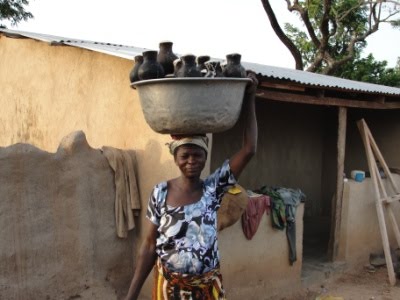
 As the rains begin to fall, the area between compounds is growing green. The stars are fantastic. Leo is spread out across the top of the sky; the familiar Big Dipper is in the north and the brilliant Southern Cross opposite it. Women walk gracefully with wood or water on their heads; they laugh at my greetings in Dagarre, the local language, not worrying for a second about spilling a drop. Amelia and her cousins dance and sing in the open space just outside of the compound door. Dery and I have conversations into the darkness about life in Canada and Ghana, often punctuated by his very Ghanaian expression of surprise, “So!” People are constantly dropping in to the compound to say hi and chat, to test my Dagarre and hopefully be the one to teach me a new phrase. In short, the place and the people have been easy to fall in love with.


This illusion has been broken for me several times over the past few weeks in ways that it hadn't been before. The day I arrived in Seripe, a man died in his house two weeks after stomach surgery. After his death I learned I had met him the week before – he was a member of one of the farmer groups and good friends with the Agric Extension Agent. I remember walking down the path to his house, but hard as I try, I can't recall his face. A week after I arrived, Dery fell off the back of a motorbike. Even though it wasn't going fast he dislocated two of his toes and hit his knee. He wasn't able to farm for a month, and the fact that the rains are late so far this year is both a blessing and a curse. He is struggling to find labourers to help clear five acres of land for a maize field in time to plough; gold was recently discovered nearby Seripe and many of the young men who used to be available as labour for hire now mine illegally instead. Philip used to attend school in Seripe but the quality of education is poor and so Dery now pays to send him and Matthew to the Upper West, losing two much needed weekend farm hands.

 More than ever, life in Seripe has shown me that poverty isn't something you can always see on the surface. I have certainly been one of those guilty of expecting that it should be. Instead it's something much more complex, much more difficult to articulate. The lack of opportunity, the vulnerabilities to shocks and stresses, the lack of access to or trust in basic services like health and education, poorly functioning markets and dependence on the weather. I have seen all of these factors at play in Seripe, but I haven't seen abject misery. The past month has been a sharp reminder that Dery's strong, proud smile as he stands with his family can still be the smile of poverty.
Picture Legend from top (and apologies as I still struggle to get pictures put into exactly the right spot!):
- Anita and Winnie, Dery's two oldest daughters
- Dery's wife carrying pito (the local drink, brewed from sorghum) to the market
- Dery, his sister and two of his sons, Philip and Matthew
- A view over the compound wall
- Amelia, Dery's youngest daughter
- Vitalis, Anita's son
- My usual sleeping place when it isn't raining (plus mosquito net).
- Freshly brewed pito, before heading to the market
- Dery
Tuesday, April 06, 2010
Two Days on A Farm (or Why It's Hard to Be an Innovative Farmer)
When you're from the city, two days on a farm can teach you a lot. I'm working in Ghana for the Ministry of Food and Agriculture but man do I have a lot to learn about farming. Two weeks ago I spent two days in Blema, a small village between Sawla and Tuna in the Sawla-Tuna-Kalba district of Northern Ghana. A good friend of mine, Troy Barrie, dropped me off on a Wednesday morning and took off on his moto, promising to return by the same time Friday.
I had the privilege of staying with a farmer named Musah who is doing some pretty incredible things in Blema. Here is a quick run down of the activities he was undertaking during the dry season, when most farmers take a break in preparation for the busy rainy season:
- Palm nut cultivation (harvesting and nursing seedlings)
- Mango grafting and cultivation
- Orange grafting
- Cashew cultivation
- Irrigated tomato and garden egg (eggplant) cultivation
- Animal husbandry (cattle, sheep, goats, chickens, guinea fowl)
- Training bullocks
Needless to say I learned a lot of practicals about farming over the two days. During the rainy season he'll add the traditional staple farming activities and also grow maize, rice, yam and cassava; in two months it will be another whole world of learning for me! What was more important to me about the two days though, was not what it taught me about farming, but rather about farmers.
Besides being an insanely hard worker, Musah is an innovator and an experimenter. Farmers don't have a lot of insulation from risk here, and even common farming activities such as growing maize and yams are highly dependent on external factors, most notably rain. To invest in new, unproven activities when your family's livelihood is at stake takes a lot of foresight and guts.
The most obvious example of Musah's experiments is his palm nut plantation. To the best of Troy's knowledge, Musah is the only farmer growing palm nut in the entire district – it is much more common in the south where the ground is softer allowing the tree's roots to grow strong and deep. Musah has some land around a stream that floods regularly during the rainy season and decided to test out some palm nut trees. Now, five years later, he has a flourishing palm nut plantation. He has continued to experiment in different places and has another plot of land where the test trees he planted three years ago have started bearing fruit. He plans to fill in the area with palm nut seedlings this year.
Another example of Musah's innovation is his grafting. He learned how to graft mangoes, combining local mangoes with varieties of mangoes that produce bigger fruits. Grafted mangoes are common in Ghana and at first this didn't especially set him apart in my mind. Then we came across a mango tree that had several grafts, six in total. Each graft was a different variety, so this tree will grow up to bear six different types of fruits, and Musah will learn which type does best.
All of this without any formal education. Musah doesn't speak a word of English – his son Alhassan translated for me as we went around the farm. Pretty incredible.
Innovation is something we like to talk a lot about in EWB and at Waterloo. When I think of innovation I think of fast-moving exciting projects, pushing the boundaries and learning quickly. I think of shortening feedback cycles, “failing fast” and constant iteration. Two days with Musah taught me that innovation in farming is a bit different. Watching him meticulously check each of his palm nut trees and grafted mangoes showed me another type of innovation. Innovation where you invest in a seedling and wait three years (three years!!!) before you reap any rewards, before you learn if your experiment worked. This innovation requires patience, doing the small things each and every day with the hope that it might pay off in the end.
In many ways all farmers face this challenge of evaluating short-term decisions against long-term outcomes, even with their regular year-to-year crops. Will the rains come early or late? Is it worth it to invest in fertilizer, herbicide or pesticide? At the end of the day, what will all of this work be worth for me? All of these questions are ambiguous in farming. Sometimes it doesn't pay off at all. I recently met a farmer group in Bole trying to do dry season vegetable gardening. They have several gardens of tomatoes that have just started flowering. Unfortunately, the wells they have been using to irrigate are drying up early this year, along with the tomatoes.
All of this adds to my respect and admiration for what Musah is doing is Blema. Being an innovative farmer is hard. Not only do you have to work hard, you need to be willing to experiment, to take risks, and to be patient.
If you've made it this far, you might be wondering, what does all this mean for EWB's work with the Ministry of Food and Agriculture and with farmers? In order to keep this from becoming another one of my excessively long posts, I'll defer that question, as it's a big one. Stay tuned, that post is on its way!
PS Below are some more pictures from the two days. Hope you enjoy!

Musah stands proudly in front of his palm nut plantation.

Musah's son Alhassan holds a palm nut seedling in the nursery.


Palm nuts! They become more red as the mature before they're ready to be harvested.
Young cashews before the fruit develops.

Alhassan shows the different types of cashew fruits.

Mature cashews ready to be bagged and sold to a processor.

Taking the bullocks to the dam to fetch water.

Look familiar? A soka (or treadle) pump. One of the technologies EWB used to promote in Southern Africa. They use this for irrigation when they don't have money for fuel for the gas pump.

Alright, fine, a picture of me... if I have to. Alhassan to my right and Musah to my left.
Friday, March 19, 2010
One Thousand Two Hundred Eighty-Eight
One Thousand Two Hundred Eighty-Eight. The number of days between leaving Ghana in 2006 and arriving in 2010. In some ways it feels like I never left. It was almost deja vu, leaving Toronto, boarding the plane to Amsterdam, spending way too much on a croissant on the layover before finally landing in the heat, humidity and darkness of Accra. After making it through customs I took a taxi with the three other EWB staff arriving with me to Madam Adisa's house, the last place I stayed in Accra before leaving last time. Adisa greeted us with her usual openness and hospitality – and a large meal of boiled yams and jollof rice. A welcome back that made it feel like I was returning to a place I knew.
I just looked back on my first month of blog posts from 2006 and it has been an interesting reflection. I managed to write about 5000 words describing my first three days or so. I can't say I'd be able to do the same this time around – the sights and sounds that were so new and exciting three years ago seem almost familiar (although the public toilets are still less than appealing and my first bowl of TZ didn't go down quite as easy as I'd hoped).
At the same time I've had the pleasure of watching Reynaldo, a new friend from my training group, go through all of those new experiences. Sitting in the back of a taxi while the driver and the person in the front seat argue at full volume in another language, learning to eat an orange like a Ghanaian, trying to get red dirt out of a white shirt. Venturing into the market is a great metaphor for the whole experience; it is colourful, dirty, crowded, loud, full of smells (good and bad) and almost certainly overwhelming. How much should things cost? Is that person yelling at me or just yelling? Am I in the way? At some point you learn to accept the chaos as normal and go on about your day as if it is.
The two of us were walking with some of the other EWB staff just by the market when Reynaldo asked a simple question. “What is that???”It was a white vehicle with its doors wide open, full of butchered cows. Halves of cows were strewn about the inside next to two cardboard boxes holding piles of folds that jiggled with the sputtering diesel engine. Upon closer inspection the consensus was that is was beef hide, something I had eaten once before. The smell of the meat made the lack of refrigeration conspicuous, just as the loud buzzing made obvious the abundance of flies. As it pulled away two simple words written in large red block letters gave Reynaldo his answer. Meat Van.
I'm sure if I'd seen such a thing on my third day in Ghana in 2006 I would have written an essay on it, but this time it hardly seemed out of the ordinary, and certainly not a shocking discovery. Later, I was sitting listening to the woman who had just cooked us some fried egg sandwiches talk about how she was expecting it to take her three years to save up the 600 GHC (or $480) to buy a container for her tailoring business when a green SUV pulled up with spotless chrome rims and the logo of an NGO painted on the door. Across the street a monkey is chained to the wall. I start to wonder what out of anything in this city should be normal. It reminds me of a story that Tahidu, my old boss and host father once told me. He spoke of an educated teacher that moved to the remote community he was assigned to, determined to do a better job by being closer, missing less of days of work and spending more time on his community. It didn't help, as the teacher became just like the community and nothing changed.
You have to adapt and learn to survive and be happy in another culture, but how far do you go? What do you stay grounded in when so many of your assumptions about what is right are challenged? I've been struggling with this question and wondering if I have too easily accepted the realities of Ghana as normal. What values do I hold on to in order to be an effective catalyst of change? It is hard enough to make change and push boundaries in your own culture, never mind the complications of being a Canadian in Ghana.
Although this question has been especially apparent to me over the past couple of weeks it is not new; it's certainly one I thought about in 2006 and since then. These are the challenges I have been looking forward to coming back to and tackling again, with a little more time and a little more depth. It's a reminder that after one thousand two hundred and eighty-eight days I'm not just coming back to familiar people, places and sensations, but familiar challenges and unanswered questions as well.
I just looked back on my first month of blog posts from 2006 and it has been an interesting reflection. I managed to write about 5000 words describing my first three days or so. I can't say I'd be able to do the same this time around – the sights and sounds that were so new and exciting three years ago seem almost familiar (although the public toilets are still less than appealing and my first bowl of TZ didn't go down quite as easy as I'd hoped).
At the same time I've had the pleasure of watching Reynaldo, a new friend from my training group, go through all of those new experiences. Sitting in the back of a taxi while the driver and the person in the front seat argue at full volume in another language, learning to eat an orange like a Ghanaian, trying to get red dirt out of a white shirt. Venturing into the market is a great metaphor for the whole experience; it is colourful, dirty, crowded, loud, full of smells (good and bad) and almost certainly overwhelming. How much should things cost? Is that person yelling at me or just yelling? Am I in the way? At some point you learn to accept the chaos as normal and go on about your day as if it is.
The two of us were walking with some of the other EWB staff just by the market when Reynaldo asked a simple question. “What is that???”It was a white vehicle with its doors wide open, full of butchered cows. Halves of cows were strewn about the inside next to two cardboard boxes holding piles of folds that jiggled with the sputtering diesel engine. Upon closer inspection the consensus was that is was beef hide, something I had eaten once before. The smell of the meat made the lack of refrigeration conspicuous, just as the loud buzzing made obvious the abundance of flies. As it pulled away two simple words written in large red block letters gave Reynaldo his answer. Meat Van.
I'm sure if I'd seen such a thing on my third day in Ghana in 2006 I would have written an essay on it, but this time it hardly seemed out of the ordinary, and certainly not a shocking discovery. Later, I was sitting listening to the woman who had just cooked us some fried egg sandwiches talk about how she was expecting it to take her three years to save up the 600 GHC (or $480) to buy a container for her tailoring business when a green SUV pulled up with spotless chrome rims and the logo of an NGO painted on the door. Across the street a monkey is chained to the wall. I start to wonder what out of anything in this city should be normal. It reminds me of a story that Tahidu, my old boss and host father once told me. He spoke of an educated teacher that moved to the remote community he was assigned to, determined to do a better job by being closer, missing less of days of work and spending more time on his community. It didn't help, as the teacher became just like the community and nothing changed.
You have to adapt and learn to survive and be happy in another culture, but how far do you go? What do you stay grounded in when so many of your assumptions about what is right are challenged? I've been struggling with this question and wondering if I have too easily accepted the realities of Ghana as normal. What values do I hold on to in order to be an effective catalyst of change? It is hard enough to make change and push boundaries in your own culture, never mind the complications of being a Canadian in Ghana.
Although this question has been especially apparent to me over the past couple of weeks it is not new; it's certainly one I thought about in 2006 and since then. These are the challenges I have been looking forward to coming back to and tackling again, with a little more time and a little more depth. It's a reminder that after one thousand two hundred and eighty-eight days I'm not just coming back to familiar people, places and sensations, but familiar challenges and unanswered questions as well.
Friday, August 04, 2006
Some Thoughts and Learnings
Just thought I’d write down a couple of my current thoughts on development and my experience here in order to get some comments/discussion happening.
I’ve had a couple of interesting discussions about the West’s role in development in Africa and whether or not Westerners should even be coming to Africa at all. My thoughts on this are still pretty scattered, but hopefully writing them down will articulate them a little bit better.
The first thing that I have come to realize is that (nearly) all of the best development work is being done by Ghanaians for Ghanaians. Almost all of the NGOs that EWB works with are indigenous to the country for that very reason. The work that these NGOs do never makes the news in the West, and I wonder if it ever will. News about Africa generally consists of war, conflict, new democracies (with focus on how fragile these new democracies are) and finally successes of Western led NGOs or multilaterals. The real work, the real successes and the real strength that this country has doesn’t make the news.
Another huge misconception that I’ve found is that all Africans want to get an education so they can move to the West. I (and other volunteers that I’ve talked to about this) was very surprised to learn that this is not at all true. I’m sure the view is so widespread because most people that one might meet in Canada from a developing nation has gotten an education and moved away. Even talking to several youth about getting educations in the West, none of them expressed much desire to stay after they had completed. One of my favourite answers was, “Why would I get an education and then use it in some place that is already developed?” I met another young man who actually did his masters in geography at Waterloo. He said his wife eventually convinced him to fly her to Canada and after a week she was ready to go home. “You think I’m enjoying Canada, but now you see how I have been suffering these past years,” was his reply to her. Just the other night I met a man who had spent seven years in the US, and is now back in Ghana because he likes it here better. I’m sure another huge reason for this horribly misplaced belief is that we in the West believe that we’re better, so why wouldn’t someone move here if they had the chance? I’ll take this chance to make this blog a little more controversial and ask you to think about your views on African migration to the West and what assumptions you might be making that are completely unjustified.
Next up, I’ve seen some of the problems caused by charity, which often has its origins in the West. The commitment level of one of the communities involved in the agro forestry project that I am working on in Kukpehi is a perfect example of this. We are now in the planting stage, and each community was to collect their allotment of seedlings from the nursery at Kukpehi before the date they had given for us to start their planting. While most of the communities had collected their seedlings, brought them to the planting site and had a large number of people helping, from children to some of the older adults, this community was nowhere near that level. We arrived at the community and we were told that they were having a meeting, and should return in about an hour. We did an errand that was planned for after the planting, and returned to about four people with only about half of the seedlings collected from Kukpehi. To give you a bit of a reference point, one of the communities we had visited the previous day had about 20 adults and at least 10 children helping us. Another community had already started planting before we arrived. The numbers slowly increased as the work went on, but not to the same level as anywhere else.
After returning to the office, we were talking about this commitment problem, and Adisa gave her explanation. She said that someone dug a large dam for their community without their involvement, and now they’ve come to expect that things should come to them instead of them working towards development in their community. This was emphasized by one of my co-workers comments that they were even asking for us to bring food next time we came! They said the government had come to help them plant their teak woodlot and had brought them food for doing the work. This is why Adisa refuses to work with programs such as the World Food Program and Food for Work. Programs like this make people believe that handouts will continue and they expect to be compensated for doing work to better their own community! This type of attitude is destructive in terms of community-driven development and completely contradicts Africa 2000’s and IPRP’s approaches.
So, where am I actually going with these points? I swear there’s some sort of coherence between them in my head, which I’ll try to get out here. For me, they’re all huge contributors to one of the questions I’ve been asking myself a lot lately: “Sure, what I’ve learned here is going to be beneficial for me and my community back in Canada, but is my placement actually good for Ghana?” This might seem like a ridiculous question at first, the obvious answer is of course it’s good, and judging by the amount of comments I get back from people about the great and amazing work I’m doing here that would be the widespread answer from all of you. I’m sorry if I’m sounding a little bit cynical here, I’m not trying to directly offend or accuse anyone with that last statement, I just feel like none of my blogs have really expressed some of the frustrations, difficulties and tough questions that come along with development.
Three topics I discussed above all have direct bearing on whether or not I am contributing, useful, or maybe harmful to the people of Ghana. My first two points were to illustrate that capacity needed to do good development work is already here. The NGOs that do great work are doing great work, and are staffed by excellent, educated Ghanaians. There are also Ghanaians who graduate every year from Ghanaian universities with development-related degrees who can’t find work. For example, we have a staff member right now doing what is called National Service. Every graduate must do a year’s work towards developing the country before finding their own job in the field of their choice. My director has commented a couple of times that she wishes she could hire him once his national service is up, but doesn’t have the budget for it. Meanwhile, she’s just received two United Nation’s Volunteers and will most likely get at least one National Service person in the fall.
In light of the previous discussion of the problems with giving things away and the expectations created in the future, I have some questions about the effect that I’m having here as a free volunteer for Africa 2000 and IPRP. If at the end of my placement it is decided that I’ve added value to A2N/IPRP and had some impact, will my director begin to expect that she can use EWB volunteers, and stop looking for Ghanaians, who might have to be paid, to play that role in the future?
I recently talked to Louis about these questions and got his answer as to why EWB is not taking Ghanaian jobs. Louis had value-added points that EWB volunteers bring the average NGO staff member in Ghana doesn’t bring.
Pro-poor approach: This might seem like something that anyone working for an NGO here would have, but it is certainly not the case. Development is an industry here, and to many people, working at an NGO is just a job. I feel like my office does not have this problem so much, but hearing the frustrations of other volunteers certainly confirms this. EWB volunteers’ livelihoods do not depend on meeting donors’ needs in order to keep funding or receive new funding. Sadly, these donor requirements don’t always make the poor the number one priority. EWB volunteers can push for pro-poor practices and policies whenever possible, and hopefully have impact in this way. Of course building the trust to make suggestions that don’t always seem to be in the NGO’s best interest takes time and hard work. I’ve been working directly with IPRP for three months now, and I am just starting to become comfortable making suggestions about how the office is run, but I have been getting a fairly positive response. To be sure that new practices turn into habits would take me another few months however, and I question the sustainability of the change that my work at the office has started.
Technical Skills: EWB volunteers certainly bring a lot of what some might call ‘Western’ skills to their placements. These range from computer skills to facilitation and management skills. I agree that some of the skills I have are not present in the office, especially in the way of computer skills. My facilitation and management skills have certainly been useful while I’ve been here and I feel like I’ve used them to add value. It is easy to see that all of the volunteers excel in these areas as well, but when you look at how and where these people were selected it’s not difficult to see why. Everyone is an EWB chapter leader from one the country’s best universities who has been trained with 22 equally great leaders. I think if the same process was applied to Ghanaian universities then leaders with the same quality would easily be found. This may not be happening now (or maybe is), but having a free source of Western volunteers certainly doesn’t help to promote the growth of young development leaders in Ghana. I just believe that the capacity to have the same skills as an EWB volunteer exists in Ghana’s youth, it just hasn’t been harnessed to its full potential yet. For example, another one of the volunteers who was excited about applying his facilitation and management skills showed up at his placement only to find out that his NGO’s staff far outshined him in this area. If there were more paid jobs looking for these types of skills at the NGO level would there be more motivation for youth to develop them? Say a large amount of the local youth do gain these skills, what NGO would hire them if they could get Western volunteers for free? How then does a country develop to the point where Western volunteers aren’t needed anymore? These are some of the questions I still have.
Flexibility: This is one of the places where I feel EWB does have a significant value added that is tougher to find locally. An EWB volunteer doesn’t have a family to worry about, and can live for weeks or months at a time in a village far away from any town or city. I have seen this problem especially at the government level, where staff of remote districts don’t even live or have offices in the districts where they are employed due to lack of accommodation and infrastructure for their families. EWB volunteers can also sidestep around some of the hierarchy that exists within organisations here. This can be extremely useful, especially when it comes to communication between various parts of an organisation.
Talking about these reasons with definitely made me feel a little bit better about what I am doing here, and I certainly wish I would’ve thought about it more earlier and asked more questions about my actual value added. I would encourage anyone who is doing any international development work to think about the impacts (positive and negative) that might result from your placement, and what value added you would have. Although it is sometimes difficult to do this beforehand and things always change, I believe asking these questions and doing some thinking is extremely helpful, and I wish I would have done it more right from the start.
I believe the most important reason is to ensure that you are not feeling discouraged and disappointed about development by the end of your placement. Based on past discussions, a lot of people go into a placement with high expectations about what they will be able to accomplish, and when they discover that impact is slow and difficult to measure they become frustrated and discouraged with development. Avoiding this is essential in my opinion, because my second reason for going through this impact/value added assessment would be to realise that the experience alone won’t have the impact you might wish, but you can use the experience to continue to have impact back in Canada. This is tough to do with a negative attitude towards development upon returning. EWB certainly realises this and the JF program certainly focuses a lot on learning and less on actually expecting and measuring the impact of a JF placement in terms of overseas work. I would recommend having a plan with goals for how you’ll use your experience back in Canada. That way you’ve always got long-term goals in mind and you’re not confined to thinking that you have to get your dollar’s worth of impact before you get on the plane home. The third reason is to be aware of your strengths as a volunteer and to take advantage of them as much as possible while overseas, while avoiding as much as possible the areas of negative impact. This contributes to your overall effectiveness and will hopefully reduce the number of days you feel like crap because you’re (more or less) completely useless in that moment of that day.
As an illustration, I feel like there are two areas where my work here is on its way to having EWB value-added impact sometime in the future. The first is simply working with A2N/IPRP and paving the way for what might become a future partnership with EWB. Despite what I’ve just said, which may have sounded a little negative, I do believe sending volunteers is a good thing, especially when the potential for impact in Canada is factored in, so a future partnership with an NGO that I believe is doing great work and offers excellent learning opportunities for volunteers will lead to positive impact in the future. The second area where I feel I’ve had value-added impact is in Kukpehi. I was lucky enough to have an opportunity to hear from everyone in the community what they felt I’d brought to their community when Louis visited with a guest named Sakiko (hopefully I’ll write about that day sometime soon). Their general response was that their attitude towards whites has changed in that they don’t see them as being so different anymore and wouldn’t be scared to ask them for help. They also said that me living and appreciating their lifestyle has given them confidence and hope for their own development. I’m really glad that I got to hear their changes of perspective, and hopefully they will last.
What really made me happy was that no one mentioned my work with the nursery project or attributed the benefits that the nursery will bring to my work there. The nursery project would have certainly happened without me and I’m very glad that they see themselves as the owners of the project, and I am simply someone who came to live and work with them. It has become obvious to me after spending time in rural Ghana (and a more urban setting for that matter) that there is certainly not a shortage of labour here. This makes me question very much the value of projects that bring Westerners to do labour work of any type in Africa. This brings me back to the point that charity and give-aways are much more destructive than the short term benefits they bring. People come to expect a certain level of charity and the motivation to remove that dependence decreases with every new building constructed by outsiders. Communities that have ownership over their own development tend to be much better off than any community that receives without any contribution. The ABCD approach stresses this and I've seen many examples of it since I've been here.
This small impact list of two is dwarfed by my plans for having impact once I return to Canada. Some of my plans for having impact in Canada have already started, for example this blog and my chapter phone call. My experience here has built my capacity to do effective education in Canada, and hopefully will be able to share my experience in order to educate and motivate Waterloo chapter members, encourage new people to join, and to inspire the next set of JFs from Waterloo.
Hopefully that was an ok balance of optimism/pessimism, but I think it’s important for me to share some of my frustrations and questions and get some feedback!
Less than three weeks and I’ll be back in Canada! I’ll be spending just less than two weeks here in Tamale and then I’ll be in Accra before heading back on the 22nd. I certainly have mixed feelings and I’m a little bit apprehensive about getting back into the Western life style, but for now I’ll just enjoy where I’m at and what I’m doing. Have a good end to your summer, and I’ll try to post again before I leave, but no promises based on my current schedule!
Just thought I’d write down a couple of my current thoughts on development and my experience here in order to get some comments/discussion happening.
I’ve had a couple of interesting discussions about the West’s role in development in Africa and whether or not Westerners should even be coming to Africa at all. My thoughts on this are still pretty scattered, but hopefully writing them down will articulate them a little bit better.
The first thing that I have come to realize is that (nearly) all of the best development work is being done by Ghanaians for Ghanaians. Almost all of the NGOs that EWB works with are indigenous to the country for that very reason. The work that these NGOs do never makes the news in the West, and I wonder if it ever will. News about Africa generally consists of war, conflict, new democracies (with focus on how fragile these new democracies are) and finally successes of Western led NGOs or multilaterals. The real work, the real successes and the real strength that this country has doesn’t make the news.
Another huge misconception that I’ve found is that all Africans want to get an education so they can move to the West. I (and other volunteers that I’ve talked to about this) was very surprised to learn that this is not at all true. I’m sure the view is so widespread because most people that one might meet in Canada from a developing nation has gotten an education and moved away. Even talking to several youth about getting educations in the West, none of them expressed much desire to stay after they had completed. One of my favourite answers was, “Why would I get an education and then use it in some place that is already developed?” I met another young man who actually did his masters in geography at Waterloo. He said his wife eventually convinced him to fly her to Canada and after a week she was ready to go home. “You think I’m enjoying Canada, but now you see how I have been suffering these past years,” was his reply to her. Just the other night I met a man who had spent seven years in the US, and is now back in Ghana because he likes it here better. I’m sure another huge reason for this horribly misplaced belief is that we in the West believe that we’re better, so why wouldn’t someone move here if they had the chance? I’ll take this chance to make this blog a little more controversial and ask you to think about your views on African migration to the West and what assumptions you might be making that are completely unjustified.
Next up, I’ve seen some of the problems caused by charity, which often has its origins in the West. The commitment level of one of the communities involved in the agro forestry project that I am working on in Kukpehi is a perfect example of this. We are now in the planting stage, and each community was to collect their allotment of seedlings from the nursery at Kukpehi before the date they had given for us to start their planting. While most of the communities had collected their seedlings, brought them to the planting site and had a large number of people helping, from children to some of the older adults, this community was nowhere near that level. We arrived at the community and we were told that they were having a meeting, and should return in about an hour. We did an errand that was planned for after the planting, and returned to about four people with only about half of the seedlings collected from Kukpehi. To give you a bit of a reference point, one of the communities we had visited the previous day had about 20 adults and at least 10 children helping us. Another community had already started planting before we arrived. The numbers slowly increased as the work went on, but not to the same level as anywhere else.
After returning to the office, we were talking about this commitment problem, and Adisa gave her explanation. She said that someone dug a large dam for their community without their involvement, and now they’ve come to expect that things should come to them instead of them working towards development in their community. This was emphasized by one of my co-workers comments that they were even asking for us to bring food next time we came! They said the government had come to help them plant their teak woodlot and had brought them food for doing the work. This is why Adisa refuses to work with programs such as the World Food Program and Food for Work. Programs like this make people believe that handouts will continue and they expect to be compensated for doing work to better their own community! This type of attitude is destructive in terms of community-driven development and completely contradicts Africa 2000’s and IPRP’s approaches.
So, where am I actually going with these points? I swear there’s some sort of coherence between them in my head, which I’ll try to get out here. For me, they’re all huge contributors to one of the questions I’ve been asking myself a lot lately: “Sure, what I’ve learned here is going to be beneficial for me and my community back in Canada, but is my placement actually good for Ghana?” This might seem like a ridiculous question at first, the obvious answer is of course it’s good, and judging by the amount of comments I get back from people about the great and amazing work I’m doing here that would be the widespread answer from all of you. I’m sorry if I’m sounding a little bit cynical here, I’m not trying to directly offend or accuse anyone with that last statement, I just feel like none of my blogs have really expressed some of the frustrations, difficulties and tough questions that come along with development.
Three topics I discussed above all have direct bearing on whether or not I am contributing, useful, or maybe harmful to the people of Ghana. My first two points were to illustrate that capacity needed to do good development work is already here. The NGOs that do great work are doing great work, and are staffed by excellent, educated Ghanaians. There are also Ghanaians who graduate every year from Ghanaian universities with development-related degrees who can’t find work. For example, we have a staff member right now doing what is called National Service. Every graduate must do a year’s work towards developing the country before finding their own job in the field of their choice. My director has commented a couple of times that she wishes she could hire him once his national service is up, but doesn’t have the budget for it. Meanwhile, she’s just received two United Nation’s Volunteers and will most likely get at least one National Service person in the fall.
In light of the previous discussion of the problems with giving things away and the expectations created in the future, I have some questions about the effect that I’m having here as a free volunteer for Africa 2000 and IPRP. If at the end of my placement it is decided that I’ve added value to A2N/IPRP and had some impact, will my director begin to expect that she can use EWB volunteers, and stop looking for Ghanaians, who might have to be paid, to play that role in the future?
I recently talked to Louis about these questions and got his answer as to why EWB is not taking Ghanaian jobs. Louis had value-added points that EWB volunteers bring the average NGO staff member in Ghana doesn’t bring.
Pro-poor approach: This might seem like something that anyone working for an NGO here would have, but it is certainly not the case. Development is an industry here, and to many people, working at an NGO is just a job. I feel like my office does not have this problem so much, but hearing the frustrations of other volunteers certainly confirms this. EWB volunteers’ livelihoods do not depend on meeting donors’ needs in order to keep funding or receive new funding. Sadly, these donor requirements don’t always make the poor the number one priority. EWB volunteers can push for pro-poor practices and policies whenever possible, and hopefully have impact in this way. Of course building the trust to make suggestions that don’t always seem to be in the NGO’s best interest takes time and hard work. I’ve been working directly with IPRP for three months now, and I am just starting to become comfortable making suggestions about how the office is run, but I have been getting a fairly positive response. To be sure that new practices turn into habits would take me another few months however, and I question the sustainability of the change that my work at the office has started.
Technical Skills: EWB volunteers certainly bring a lot of what some might call ‘Western’ skills to their placements. These range from computer skills to facilitation and management skills. I agree that some of the skills I have are not present in the office, especially in the way of computer skills. My facilitation and management skills have certainly been useful while I’ve been here and I feel like I’ve used them to add value. It is easy to see that all of the volunteers excel in these areas as well, but when you look at how and where these people were selected it’s not difficult to see why. Everyone is an EWB chapter leader from one the country’s best universities who has been trained with 22 equally great leaders. I think if the same process was applied to Ghanaian universities then leaders with the same quality would easily be found. This may not be happening now (or maybe is), but having a free source of Western volunteers certainly doesn’t help to promote the growth of young development leaders in Ghana. I just believe that the capacity to have the same skills as an EWB volunteer exists in Ghana’s youth, it just hasn’t been harnessed to its full potential yet. For example, another one of the volunteers who was excited about applying his facilitation and management skills showed up at his placement only to find out that his NGO’s staff far outshined him in this area. If there were more paid jobs looking for these types of skills at the NGO level would there be more motivation for youth to develop them? Say a large amount of the local youth do gain these skills, what NGO would hire them if they could get Western volunteers for free? How then does a country develop to the point where Western volunteers aren’t needed anymore? These are some of the questions I still have.
Flexibility: This is one of the places where I feel EWB does have a significant value added that is tougher to find locally. An EWB volunteer doesn’t have a family to worry about, and can live for weeks or months at a time in a village far away from any town or city. I have seen this problem especially at the government level, where staff of remote districts don’t even live or have offices in the districts where they are employed due to lack of accommodation and infrastructure for their families. EWB volunteers can also sidestep around some of the hierarchy that exists within organisations here. This can be extremely useful, especially when it comes to communication between various parts of an organisation.
Talking about these reasons with definitely made me feel a little bit better about what I am doing here, and I certainly wish I would’ve thought about it more earlier and asked more questions about my actual value added. I would encourage anyone who is doing any international development work to think about the impacts (positive and negative) that might result from your placement, and what value added you would have. Although it is sometimes difficult to do this beforehand and things always change, I believe asking these questions and doing some thinking is extremely helpful, and I wish I would have done it more right from the start.
I believe the most important reason is to ensure that you are not feeling discouraged and disappointed about development by the end of your placement. Based on past discussions, a lot of people go into a placement with high expectations about what they will be able to accomplish, and when they discover that impact is slow and difficult to measure they become frustrated and discouraged with development. Avoiding this is essential in my opinion, because my second reason for going through this impact/value added assessment would be to realise that the experience alone won’t have the impact you might wish, but you can use the experience to continue to have impact back in Canada. This is tough to do with a negative attitude towards development upon returning. EWB certainly realises this and the JF program certainly focuses a lot on learning and less on actually expecting and measuring the impact of a JF placement in terms of overseas work. I would recommend having a plan with goals for how you’ll use your experience back in Canada. That way you’ve always got long-term goals in mind and you’re not confined to thinking that you have to get your dollar’s worth of impact before you get on the plane home. The third reason is to be aware of your strengths as a volunteer and to take advantage of them as much as possible while overseas, while avoiding as much as possible the areas of negative impact. This contributes to your overall effectiveness and will hopefully reduce the number of days you feel like crap because you’re (more or less) completely useless in that moment of that day.
As an illustration, I feel like there are two areas where my work here is on its way to having EWB value-added impact sometime in the future. The first is simply working with A2N/IPRP and paving the way for what might become a future partnership with EWB. Despite what I’ve just said, which may have sounded a little negative, I do believe sending volunteers is a good thing, especially when the potential for impact in Canada is factored in, so a future partnership with an NGO that I believe is doing great work and offers excellent learning opportunities for volunteers will lead to positive impact in the future. The second area where I feel I’ve had value-added impact is in Kukpehi. I was lucky enough to have an opportunity to hear from everyone in the community what they felt I’d brought to their community when Louis visited with a guest named Sakiko (hopefully I’ll write about that day sometime soon). Their general response was that their attitude towards whites has changed in that they don’t see them as being so different anymore and wouldn’t be scared to ask them for help. They also said that me living and appreciating their lifestyle has given them confidence and hope for their own development. I’m really glad that I got to hear their changes of perspective, and hopefully they will last.
What really made me happy was that no one mentioned my work with the nursery project or attributed the benefits that the nursery will bring to my work there. The nursery project would have certainly happened without me and I’m very glad that they see themselves as the owners of the project, and I am simply someone who came to live and work with them. It has become obvious to me after spending time in rural Ghana (and a more urban setting for that matter) that there is certainly not a shortage of labour here. This makes me question very much the value of projects that bring Westerners to do labour work of any type in Africa. This brings me back to the point that charity and give-aways are much more destructive than the short term benefits they bring. People come to expect a certain level of charity and the motivation to remove that dependence decreases with every new building constructed by outsiders. Communities that have ownership over their own development tend to be much better off than any community that receives without any contribution. The ABCD approach stresses this and I've seen many examples of it since I've been here.
This small impact list of two is dwarfed by my plans for having impact once I return to Canada. Some of my plans for having impact in Canada have already started, for example this blog and my chapter phone call. My experience here has built my capacity to do effective education in Canada, and hopefully will be able to share my experience in order to educate and motivate Waterloo chapter members, encourage new people to join, and to inspire the next set of JFs from Waterloo.
Hopefully that was an ok balance of optimism/pessimism, but I think it’s important for me to share some of my frustrations and questions and get some feedback!
Less than three weeks and I’ll be back in Canada! I’ll be spending just less than two weeks here in Tamale and then I’ll be in Accra before heading back on the 22nd. I certainly have mixed feelings and I’m a little bit apprehensive about getting back into the Western life style, but for now I’ll just enjoy where I’m at and what I’m doing. Have a good end to your summer, and I’ll try to post again before I leave, but no promises based on my current schedule!
Sunday, July 16, 2006
What I do here
Well, at long last I've finally found some time to answer that question that a lot of you have probably been asking: "What the heck is Ben actually doing in Ghana?" It has been a pretty mixed bunch of activities, but I'll try to go through them more or less as they happened.
Who I work for
First off I should explain who I work for as it's a little bit complicated. My placement is officially with an NGO called Africa 2000 Network (A2N), which is based out of Accra in the South, and does work in every region of Ghana. It is a UN founded NGO and is also primarily funded through the UN. The director of Africa 2000 Network is Madam Adisa Lansah Yakubu (Madam Adisa) who is an absolutely amazing lady. She has been the director of the NGO since its inception in 1989 and has decades of experience in development, both in terms of field work and work within the UN system.
Although my placement is with A2N, I work much more directly with the Integrated Poverty Reduction Programme (IPRP), which is based in Tamale in the Northern Region. IPRP began as a CBO and is now a registered NGO, but basically acts as the Northern implementing field office for A2N. The director of IPRP is Mr. Tahidu, who is also an amazing man who is taught me an incredible amount about development work in the field. I am also living at his house when I am in Tamale, and so we've had a lot of discussions over the couple of months I've been here. I eventually want to write an entire blog entry on him, but it will take awhile for me to organise my thoughts on that. IPRP also has an accountant named Mohammed, a national service person (Musah) and a field officer (Latifah). National service is a program in Ghana were every graduate from post-secondary education must work for a year to promote development within the country before they find their own work. Everyone in the office is a lot of fun, and Musah especially is always good for laughs whenever we are all together.
What I've done
Sagnerigu Women's Centre
I spent my first couple of weeks spending time at one of the women's training centres that A2N runs in a community on the fringes of Tamale called Sagnerigu. While I was there, a group of Japanese from JICA (the Japanese international development department), JETRO (the Japanese external trade something or other) and a man from a Japanese company were training a group of women (and one man) to make shea butter soap to be sold on the Japanese market. There are other groups at the centre that produce the shea butter and groundnut oil that is required for the soap production itself. I didn't exactly contribute much to this project, as I knew nothing about shea butter or soap, but I learned a lot about how IPRP and A2N operate and started to get to know everyone at the office and build some trust with my director(s) and office staff at IPRP.
ABCD training at Walewale
My next real project was a training session at Walewale, a couple of hours north of Tamale in the Northern Region. We were running a training session on an approach to development called Asset Based Community Development (ABCD) for Assemblymen and Assemblywomen in the Walewale district. These people are basically people elected by each community to represent them in the District Assembly, which is the local level of government. These representatives don't really get any offical training on how to help their communities develop, and thus there is often a huge gap between the District Assemblies and the communities themselves.
Enter ABCD. This approach looks to remove any mention of poverty, poor, or needs from the process of community development. The idea that communities are poor and need outside help to do anything is constantly reinforced, and it is very easy for people and communities to believe that they cannot do anything for themselves. ABCD aims to help people realise what assets they already have within their communities and to empower them and give them the confidence to start using those assets to begin development within their own communities. I could write for a long time about it, but I'll try to summarise the approach in a couple of main points.
Appreciative Inquiry
When entering and working with a community, ABCD advocates the appreciative inquiry approach. The concept is to ask questions in order for people to talk about past successes, their strengths, community member's strengths etc, and to complete avoid questions regarding needs or problems. This leaves the community feeling good about itself and ready to take those assets and strenghts and move forwards.
Asset Mapping
Several types of participatory mapping techniques are used to map physical, natural and social assets or capital. After these assets are mapped, the community moves on to...
Leaky Bucket Economic Analysis
Here, the community looks at their community as a bucket, with outside inputs (support from the district assembly, NGOs, remittances), assets and skills within their community (inside the bucket) and leakages in the bucket which cause assets to leave the community (buying firewood, fuel, transportation costs etc.). The community the brainstorms various ways to use the assets they have to generate more income or plug the leakages in their bucket.
Action Planning
Once the previous brainstorming is finished, the communities prioritise which activities they want to undertake and start planning how they will be accomplished.
The overall concept is that the problems and needs within the community will be addressed, but from a different angle. Empowering the community and making the shift from community members as clients of NGOs or the government to community members as citizens within a society is the overall goal of the approach.
That is an extremely brief summary, but I hope it gets across the general idea of what ABCD is. Please post any questions you have about anything, I'll be happy to clarify wherever I can.
Village stay at Nwodua
I spent a week living in a village about 45 minutes northwest of Tamale. I lived with the Assemblyman for the area and learned a lot about the successes they have had and the problems they are still facing.
The community has been working with Madam Adisa since before A2N even existed, and the results have been pretty incredible. They have gone from having zero formally educated people in their village to having a primary school, adult primary school, junior secondary school and vocational institute within the village itself.
One of the primary ways this has been able to happen is through the establishment of a tree nursery in the village. The tree nursery was initially started to provide trees for an agro forestry project (which I'll explain more in my Kukpehi entry) and now generates income through the selling of grafted mango seedlings and other seedlings that are raised there.
Nwodua was very focused on functional education in their community, and thus have been very successful in that respect. Some of the problems they still face are in the way of income generation. Since there was such a focus on education, income generation for women and youth (outside of the nursery) was not addressed as well as it should have been.
Kukpehi
I had planned to post another entry on general learnings and the like but it looks like this one took all day and you'll have to wait!
Well, at long last I've finally found some time to answer that question that a lot of you have probably been asking: "What the heck is Ben actually doing in Ghana?" It has been a pretty mixed bunch of activities, but I'll try to go through them more or less as they happened.
Who I work for
First off I should explain who I work for as it's a little bit complicated. My placement is officially with an NGO called Africa 2000 Network (A2N), which is based out of Accra in the South, and does work in every region of Ghana. It is a UN founded NGO and is also primarily funded through the UN. The director of Africa 2000 Network is Madam Adisa Lansah Yakubu (Madam Adisa) who is an absolutely amazing lady. She has been the director of the NGO since its inception in 1989 and has decades of experience in development, both in terms of field work and work within the UN system.
Although my placement is with A2N, I work much more directly with the Integrated Poverty Reduction Programme (IPRP), which is based in Tamale in the Northern Region. IPRP began as a CBO and is now a registered NGO, but basically acts as the Northern implementing field office for A2N. The director of IPRP is Mr. Tahidu, who is also an amazing man who is taught me an incredible amount about development work in the field. I am also living at his house when I am in Tamale, and so we've had a lot of discussions over the couple of months I've been here. I eventually want to write an entire blog entry on him, but it will take awhile for me to organise my thoughts on that. IPRP also has an accountant named Mohammed, a national service person (Musah) and a field officer (Latifah). National service is a program in Ghana were every graduate from post-secondary education must work for a year to promote development within the country before they find their own work. Everyone in the office is a lot of fun, and Musah especially is always good for laughs whenever we are all together.
What I've done
Sagnerigu Women's Centre
I spent my first couple of weeks spending time at one of the women's training centres that A2N runs in a community on the fringes of Tamale called Sagnerigu. While I was there, a group of Japanese from JICA (the Japanese international development department), JETRO (the Japanese external trade something or other) and a man from a Japanese company were training a group of women (and one man) to make shea butter soap to be sold on the Japanese market. There are other groups at the centre that produce the shea butter and groundnut oil that is required for the soap production itself. I didn't exactly contribute much to this project, as I knew nothing about shea butter or soap, but I learned a lot about how IPRP and A2N operate and started to get to know everyone at the office and build some trust with my director(s) and office staff at IPRP.
ABCD training at Walewale
My next real project was a training session at Walewale, a couple of hours north of Tamale in the Northern Region. We were running a training session on an approach to development called Asset Based Community Development (ABCD) for Assemblymen and Assemblywomen in the Walewale district. These people are basically people elected by each community to represent them in the District Assembly, which is the local level of government. These representatives don't really get any offical training on how to help their communities develop, and thus there is often a huge gap between the District Assemblies and the communities themselves.
Enter ABCD. This approach looks to remove any mention of poverty, poor, or needs from the process of community development. The idea that communities are poor and need outside help to do anything is constantly reinforced, and it is very easy for people and communities to believe that they cannot do anything for themselves. ABCD aims to help people realise what assets they already have within their communities and to empower them and give them the confidence to start using those assets to begin development within their own communities. I could write for a long time about it, but I'll try to summarise the approach in a couple of main points.
Appreciative Inquiry
When entering and working with a community, ABCD advocates the appreciative inquiry approach. The concept is to ask questions in order for people to talk about past successes, their strengths, community member's strengths etc, and to complete avoid questions regarding needs or problems. This leaves the community feeling good about itself and ready to take those assets and strenghts and move forwards.
Asset Mapping
Several types of participatory mapping techniques are used to map physical, natural and social assets or capital. After these assets are mapped, the community moves on to...
Leaky Bucket Economic Analysis
Here, the community looks at their community as a bucket, with outside inputs (support from the district assembly, NGOs, remittances), assets and skills within their community (inside the bucket) and leakages in the bucket which cause assets to leave the community (buying firewood, fuel, transportation costs etc.). The community the brainstorms various ways to use the assets they have to generate more income or plug the leakages in their bucket.
Action Planning
Once the previous brainstorming is finished, the communities prioritise which activities they want to undertake and start planning how they will be accomplished.
The overall concept is that the problems and needs within the community will be addressed, but from a different angle. Empowering the community and making the shift from community members as clients of NGOs or the government to community members as citizens within a society is the overall goal of the approach.
That is an extremely brief summary, but I hope it gets across the general idea of what ABCD is. Please post any questions you have about anything, I'll be happy to clarify wherever I can.
Village stay at Nwodua
I spent a week living in a village about 45 minutes northwest of Tamale. I lived with the Assemblyman for the area and learned a lot about the successes they have had and the problems they are still facing.
The community has been working with Madam Adisa since before A2N even existed, and the results have been pretty incredible. They have gone from having zero formally educated people in their village to having a primary school, adult primary school, junior secondary school and vocational institute within the village itself.
One of the primary ways this has been able to happen is through the establishment of a tree nursery in the village. The tree nursery was initially started to provide trees for an agro forestry project (which I'll explain more in my Kukpehi entry) and now generates income through the selling of grafted mango seedlings and other seedlings that are raised there.
Nwodua was very focused on functional education in their community, and thus have been very successful in that respect. Some of the problems they still face are in the way of income generation. Since there was such a focus on education, income generation for women and youth (outside of the nursery) was not addressed as well as it should have been.
Despite learning a lot from the people at Nwodua about their struggles and success, I left my stay feeling frustrated and less optimistic about having any impact in my field work. The community ownership and dependence problems I saw along with the lack of income generating activities (especially for the women) were deep rooted mature problems that I didn’t even have the slightest clue how to even begin addressing had I the time or the resources.
I realize that I was only there for a week, and certainly didn’t have time to have impact on a project that has been running for over a decade. I’ve thought about my time at Nwodua since then, especially in light of my continuing time at Kukpehi (see below) and I think there were a couple of reasons for my frustration.
First off, I made a lot of mistakes. Mr. Paul who I stayed with is the head of the small Catholic Church in the community, and hence there are often priests which come to stay at Nwodua to learn Dagbani before beginning their mission work. This was apparent when I arrived and was promptly asked what I would prefer to eat, when I would like to eat it, whether I needed my bath water heated etc. I was a little overwhelmed and told them that I would simply eat what they ate, when they ate it, and had no special requests or needs. This was a step in the right direction for me, but I didn’t have the confidence or experience to really shake off the special treatment. I was given my own room to sleep in, served my meals in that room and not bothered for or about anything. I spent almost all of my time with the few in the village that usually spend time with the Western visitors and did a horrible job of trying to integrate with the rest of the community. I think after the week was over I was pretty disappointed with myself, and didn’t feel that I had really gained as much out of the experience as I could have.
The second reason I was so frustrated was the fact that I was only there for a week. I was really just another short time visitor that came to Nwodua just leave without really contributing. I was talking to a group of the youth one evening about this and they definitely felt the same way. The told me that so many people from all around the world had come to visit Nwodua to learn from them but not once had anyone from Nwodua ever traveled outside of their country. Their request to me was to find someway to raise the funds to give one of them the chance to travel. It was tough to explain that I am student still trying to pay for school, while at the same time I couldn’t deny that I was there, there was money somewhere that paid for my trip, but no money to pay for theirs. Here was a community that was working so hard for its own development, and here I was, another Western coming to take away what I could without having anything to offer in return.
If I wasn’t helping I felt like I could only be hurting, especially when it comes to reinforcing stereotypes of Westerners, which are probably more like truisms in Nwodua at this point. This makes me think of an analogy used at conference this year when we were talking about the responsibilities of a Junior Fellow. The impact that we have overseas in four months will never amount to the cost of our placement, and we’ll be like runners chasing an ever advancing finish line. I felt exactly like that runner, and I know that I’ve still got a long race ahead of me.
Kukpehi
If Nwodua left me feeling confused and frustrated, Kukpehi has restored my hope and energy. Kukpehi is a fairly small village of about 450 people that is 15 kilometers due west of Tamale. Farming and animal rearing are by far the dominant economic activities, including the usual crops of maize, yam, rice, okru and soy beans. The grassy areas between houses are filled with goats, sheep, chickens and guinea fowl while the cattle graze in fields that are essentially being fertitlized for next year. There is no electricity save two small solar panels which provide lights for the mosque (and adult literacy classes during the evenings of the dry season) and also charge batteries. The community’s water source is a small dam (basically a hole dug out of the earth in a low lying area to catch groundwater run off) about a kilometer from the village houses.
There has been a lack of rains up to this point this year, so the water is getting muddier by the day. I sometimes wonder about bathing when I can’t see the bottom of the bucket. It’s then that I think of the three year old in my house smiling at me drinking out of an old metal container and I just feel guilty about the bags of ‘pure water’ Mr. Tahidu insisted I bring with me. The crops are underdeveloped and the maize stalks bow to the harsh sun instead of standing tall and healthy. Many of the fields have been plowed once and are now growing over with weeds again as the farmers wait for the rains to come before they sow.
It is here that I have fallen in love with the people, the quiet and my spot on the hard concrete floor of my host father’s room. The village has an energy and drive about it that is difficult to explain, but so easy to be a part of. It feels so natural when I’m there, but as I sit here writing these words I struggle to understand how it is even possible. I’ve been lucky enough to spend my last two workweeks living in Kukpehi working with the people on a new tree nursery/agro forestry project that is similar to the one in Nwodua.
The concept behind the project is to target the environment as an asset that needs to be both taken care of and even developed to help the livelihoods of the people. The idea is for one community to start a tree nursery in order to supply tree seedlings for itself and several of the surrounding communities. These seedlings are used in agro forestry, which is simply the intercropping of trees in farmer’s fields. The benefits of this practice are many, starting with its positive effect on the soil degradation that continues to reduce crop yields in the area. Firewood is also becoming increasing scarce as more and more trees are cut to provide fuel for cooking. Fast-growing, dry trees are a large focus of the project to provide a source of firewood to curb the cutting of other economic trees in the area. Agro forestry also helps prevent and fight bush fires, as farmers have a vested interest in their trees, will not start bush fires, and also community fire fighting groups. IPRP also plays the role of educating the communities about the benefits of agro forestry and its importance in sustaining an already vulnerable environment.
After the agro forestry of the project has been running for some time and trees have been successfully transplanted into farmer’s fields and woodlots, the project will make a transition into a sustainable income generating activity. In addition to the seedlings for agro forestry, economic seedlings such as mangoes will also be raised and sold. The community will be taught how to graft local mangoes with mangoes from Burkina Faso, in order to have a more drought resistant mango which bares large fruits (like the kind usually seen in Canada) as opposed to the smaller, yellow mangoes that dominate here.
Since I have been in Kukpehi I have basically been acting as a field officer from IPRP. I have been doing some busy work clearing the nursery, collecting new seedlings that are sprouting at this time of year, and planting some new beds of seedlings. The new beds have germinated already, and are doing well! Everyone’s pretty excited about what is happening and community participation is high, especially in the children, who fetch water every day after school.
Kukpehi is off to a great start, but where I think my real role is in the project is trying to keep things sustainable with a high level of community involvement. I want to avoid the current situation at Nwodua, where the village champions there are beginning to feel like the community is dependent on them, which to some extent they may be. Alhasson could easily fall into a role where he is responsible for too much in the community. He recognizes this, and we have started to find ways in order to make sure the nursery never becomes dependent on him.
In order to address this issue, there will be a general meeting while I’m gone to decide on a schedule for small groups to work in the nursery. At the moment, everybody comes out everyday to work in the nursery. This is not a problem now because the rains are extremely late this year, and thus the men are not out in the fields farming. I am not sure how the arrival of the rains (however late they may be) and the increase in farming activity will affect the community participation. We decided that small groups and assigned days of work would be the best way to ensure that the proper watering and care of the nursery happens on a day to day basis.
In order to sort out these details, Kukpehi is having a general meeting while I’m away to create and organize the small groups, and also to draft a two month plan for the nursery. Concrete planning and goal setting is something that I feel is important for communities to begin doing. It allows them to measure their progress, feel good about their accomplishments and it keeps the project from becoming stale. This type of planning is an area where I believe IPRP has a ‘learning opportunity’, and I’m hoping that implementing it in a community where IPRP will carry on my work after I’m gone will encourage IPRP to continue using it in other communities. I’m beginning to wonder if my plans for impact and behaviour change in my last few weeks aren’t a bit too ambitious, but hopefully between IPRP and the community a practice of regular planning will continue.
I’m really looking forward to the last week or so that I’ll spend in Kukpehi. It looks like I’ll get to do some farming (I’ve just learned that it rained there a couple of times this weekend, so everyone should be back out in the fields when I return!), I want to spend some more time with the women, and continue work in the nursery. I also can’t wait to make a fool of myself again at another one of the local dances.
The last night I was there they had what is called a Simpah (not sure about the spelling on that one) dance, which was just incredible. When we showed up, things were already under way and the atmosphere and energy was beyond anything else I’ve ever experienced. Four people play drums, with one playing taller bongo-type drums, one playing a simple rhythm stick on the side of the drums, one playing something closer to a djimbe, and the fourth playing a kick drum and a small, clearly locally made cymbal. The beat is intense. The drums are amazing, but the cymbal is what gives everything the energy. It doesn’t ring much and has a dull metallic clang, making it feel like machinery that is driving relentlessly forward. My description does nothing close to justice, you’ll just have to come and see it for yourself some time.
After watching for a while, and unsuccessfully having a try at the drums it was finally my turn to learn to dance. Everyone stopped and made a circle around me and one of the other youth. As the music started I tried to follow his footsteps and hand movements and just general motion. This led to regular eruptions of laughter whenever I did something horribly wrong, and shouts of encouragement when I managed to get a few steps right. After a few minutes of trying to concentrate through my own smiles and laughter, the music finally stopped and a cheer went up. After a few handshakes, and a couple botched attempts at answering some of the people in Dagbani, Alhasson and I headed home to bed. It was after midnight, but as we made the journey back home the beat started again and I couldn’t shake the image of everyone dancing together under the moonlight. I settled into bed and eventually fell asleep with the sound of bass drum still driving forward still penetrating the night.
Despite what I feel has been a much better stay than Nwodua, I can’t help but feel that I would need to spend a lot more time at Kukpehi to really get to understand who they are and for them to understand me. I think that mutual understanding is key to successful development when it comes to volunteers and workers from foreign countries, but I’ll write a lot more about that later. I’ve had several offers of land for farming and been asked when we should start building my house, which in some fantasy world in my head I could accept. I feel like I still have so much to learn, and that things are just beginning, instead of coming to a close. My biggest wish is definitely to learn more Dagbani so I can talk directly to the women and children of the village, because right now there’s a huge demographic of people that I have so many questions for and still have so much to learn from.I had planned to post another entry on general learnings and the like but it looks like this one took all day and you'll have to wait!
Friday, June 23, 2006
Before I forget, a couple quick additions: Go Black Stars! For those of you who are out of the football (soccer) loop, Ghana's national team the Black Stars beat the US on Thursday night to qualify for the second round in their first ever appearance at the World Cup. Everyone here is extremely excited, although our next match is against Brazil, which will be very difficult. To answer your question Jason, I was in a village about 45 minutes from Tamale, and we watched the game live on a black and white tv, so we knew right away!
Also, check out the EWB front page at www.ewb.ca for a pic of me at a bus stop... that's right, that's me with the short hair if you can recognize me!
I hope all is well with everyone back at home, and I'll write again soon!
Also, check out the EWB front page at www.ewb.ca for a pic of me at a bus stop... that's right, that's me with the short hair if you can recognize me!
I hope all is well with everyone back at home, and I'll write again soon!
“Ahh, you see there? Four people will ride that motorbike into town!”
“O!”
“It’s family car hey! Heh heh heh, a family car. Sometimes you’ll even see five.”
It is little moments like these, where Mr. Tahidu will make some obvious observation, that remind me of the differences between Canada and Ghana. Looking at what we would call a family car in Canada and a small motorbike is an interesting comparison. This particular example illustrates one of the most difficult questions I find myself constantly asking while living in Tamale. What defines actual inadequacy in terms of poverty, and what just appears to be so, based on the Western definition which assumes excess comfort? Functionally, the motorbike is a perfect means of transportation for the four people. It is much cheaper than a taxi or car, and much faster than walking however many kilometers to school. In this way the father can affordably make sure his children have made it to school. At the same time, only the father has a helmet, and the way some people drive motorbikes here makes me nervous when I’m driving in the truck. Certainly there will be some risk of accident, but such risks exist in Canada walking down the street as well. If the girls each had a helmet, would the motorbike then be an adequate means of transportation? The question applies to so many daily experiences, and it is never an easy one to answer.
It has been some time since I’ve written about any specific event, because life has been much less fantastical than it was for the first few days, so I’ll skip out of the first person narrative and give you a general description of my day to day life and experiences over the past few weeks living in Tamale. I was going to try to put everything in one post, but I think it makes more sense to post what I've written so far. Hope you enjoy!
Home Life
I’m getting to like home life more and more, and my family is both amazing and a lot of fun. A standard day goes like this:
~5:20 am: The mosque two lots down starts loudly blaring the morning call to prayers. I roll over and unsuccessfully try to block it out, while Mumin hauls himself out of bed to get ready to go for prayers. This is usually accompanied by a few loud calls from his mother ‘Mumin! Mumin!’
~5:45 am: The roosters are usually wide awake and letting everyone know at this point. Mumin is sleeping again, so I try to ignore the sun for a few more minutes
~5:45 am - ~ 6:30 am: Mix of being asleep and awake, the noises of the roosters and the people outside get louder and louder, and there may or may not be several people in my room talking already. At some point in here, I manage to commit to sitting up and starting the day.
6:30 am – 7:00 am: A bag of hot Koko (which I now thoroughly enjoy) and a piece of bread are already waiting for me on the desk. I eat quickly, and before I finish someone always comes in to tell me that my bath water is ready.
7:00 am – 7:25 am: Ahhhh, a bath (well, not really a bath, a shower like I described before) with cool water to wash away that shirt-stuck-to-you morning stickiness.
7:25 am – 7:50 am: If I’m lucky, it only takes me 25 minutes to iron my clothes.
7:50 am ~ 5:00 pm: Off to work.
5:00 pm – 6:30 pm: Free time to play guitar, football, read, hang out with Mumin and the guys from the neighbourhood etc. Relaxation time in general. This time has recently also turned into cooking time with the women, which is even better than relaxation time. More about this below.
6:30 pm – 7:30 pm: Dinner time! Usually TZ, but the odd day we’ll have rice (see food section below).
7:30 pm – 8:30 pm: Wait for everyone to finish dinner (those who go for prayers usually eat later than the younger kids and I) and then wash dishes with the girls while they teach me Dagbani.
8:30 pm – 9:30 pm: Catch up on the latest football match, Nigerian film, or Ghanaian TV show if I can manage to stay awake through the whole thing.
~9:30 pm: To bed early because it will be early to rise the next morning!
Despite my somewhat sarcastic remarks when it comes to the morning, I love having a family to live with. I’ve learned so much in terms of language, local food, Ghanaian family life and local customs.
The biggest obvious difference between family life here and in Canada is the amount of household chores done by women as compared to men. The women of the house (Mr. Tahidu’s wife and his wife’s sister) do a lot of the cooking and some of the cleaning, but it’s the girls (Rashida and Azara, they are not Mr. Tahidu’s daughters, but rather his sister’s, and are staying here to attend school) of the house that are the most amazing. They are always sweeping, cleaning, cooking, washing or something, but despite this are always smiling, laughing, joking and singing. Hanging around with them and washing clothes or dishes is one of my favourite things to do (even though I’m horrible at both, the girls can wash everything from their feet and bending over, while they always make sure I have a chair to sit in before we start, there’s no way I’d make it otherwise). I’ve also recently been helping cook the nightly TZ! I had a couple of pictures taken when Madam Adisa (I think I probably called her Madam Yakubu in earlier posts) was in town, so hopefully I’ll have a copy of one of them to post here. The girls’ energy is infectious, and they love helping me with my Dagbani, which is always fun because they’re still young and their English is not perfect yet either. One of the best parts of the day is coming home from work and walking into the house to one of the girls’ huge smiles, and a “Mr. Ben! Aninula!” (good evening).
Spending time with the girls usually means that my youngest brother Rashid is also around, and he’s a bit of a goofball. He and the girls always get into friendly arguments, name calling and play fights, and I’m constantly told one thing by the girls, to which Rashid replies ‘Don’t mind them,’ and vice versa, so I’m always entertained.
I also enjoy just hanging around with my older brothers and their (well, mine now too I guess) friends from the neighbourhood. There is Mumin, who I talked about in the last blog and then Mohammed, who is in senior secondary school. We usually have a good time just sitting around chatting (they always want to hear about Canada), or playing football (soccer), and tossing the occasional Frisbee. I haven’t had a game of ultimate going yet but one of these weekends it’s going to happen; most people are pretty excited about the prospect of a new sport. Hopefully it’ll catch on and we’ll have a decent game by the time I leave!
Really spending time with the older women of the household has been difficult, since none of the speak English in any substantial amount, but they enjoy my attempts at greeting correctly (which are getting pretty good) and the simple questions that I can answer. It’s really tough to go from Canada where I can carry on a pretty good conversation with just about anyone, to here where I can’t even speak with my host mother, but more on language later. Helping with the cooking has been the best way to spend time with my host mother and have laughs with her (almost always directed at my cooking attempts), and has been a highlight for me recently.
The single most important item I packed (other than my malaria meds) is my guitar! I brought it out on the second day and since then I can’t go an afternoon without requests for “Breakfast at Tiffany’s” which is by far everyone’s favourite song. At any time in the day one of the girls will be humming it or singing made-up non-words along with the chorus, although they’re starting to sound more and more like English. I’ve even had requests from my host mother to teach her the words when I get the chance! I wrote the lyrics for some of the older boys who can read and so sometimes I have a pretty good chorus of voices behind me. A couple other favourites are “Brian Wilson” and “Wonderwall”, which are next on the list for me to write out.
I’ve also met a ton of people in my neighbourhood, and most people seem to know who I am and that I’m staying with Mr. Tahidu, despite me never having talked with them before. People are always eager to sit and chat and teach me a little more Dagbani, so the 5-minute trip to the Internet café usually gets drawn out to about 20 minutes each way. I’m still absolutely horrible with names, and usually can’t pronounce them on any of my first five tries, let alone remember them before I get to the end of the conversation.
Family life has easily been the most important and influential part of my stay here so far, especially if you count Mr. Tahidu under family instead or work (he gets his own section later). The initial break-off from the group living in Tamale was difficult, and my first few days were frustrating, but now it is so obvious the richness that the challenge has brought to my stay here. Even spending time with a few other EWBers in town on weekends makes me feel like such an outsider and out of place compared to my regular walk down the stretch in Lamashegue. Cultural integration just doesn’t happen by hanging out with other Westerners.
Food
Well, I’ve been experiencing a lot of local Ghanaian food since I’ve moved in with my family and started work, so it gets its own section! In general I’ve been doing alright with the food, but the constant barrage of maize-based dishes that I eat for almost every meal does tend to get a little monotonous. All in all I can’t complain however, as I enjoy the food for the most part, and after hearing the daily diet of some of the other folks that aren’t in town, I’m extremely thankful.
Breakfast is the same every day (koko and bread) so I’ll jump into lunch. I usually have one of about four choices for lunch, kenkey, banku, fufu, or rice, which makes it easily the most interesting meal of the day. Kenkey and banku are both maize-based, and although I’m not completely sure of the difference between them, it seems to me that kenkey is drier and a little less fermented than banku. I usually take my kenkey with a fish and some sort of soup to dip it in (I still have no idea what the different types of soup are), and the banku with soup and beef. Fufu is basically mashed potatoes made from yam that you then dip into whatever soup you happen to have selected. Rice is the same idea, and is extremely wet and sticky, so you can make proper little balls from it to dip you’re your soup. Despite not enjoying banku the first time I tried it in Accra, it’s becoming one of my favourites because it actually has taste! Once the outer layer of soup has come off in your mouth, the chunk of starch that you’re left with is actually still interesting, unlike the others, especially fufu I find, which becomes less like enjoying food and more like trying to swallow the leftover paste.
TZ is the dish we have pretty much every night with almost no exception. It’s a maize-based dish (of course), and is eaten like every other Ghanaian dish. It is not sour at all like banku, and is a lot less sticky. At least there’s usually some variety in the soup that we take with the TZ, but I’m definitely happy on the off night when I open my dish and find rice.
I’m still horrible when it comes to eating technique. I take a long time and can never manage to finish off my soup with the amount of TZ I’m given like everyone else. I’m also usually a complete mess by the end of the whole process, and very thankful for the near complete darkness that I’m eating in by the time dinner is served. I was trying to learn the proper technique for using my hand as a spoon so that I can finish all of my soup, but it seems that I always end up with soup on my face and a thumb in my instead.
Meat in general is always interesting too, and I’ve become a pro at sucking every last bit of whatever supposedly edible part of the animal that is floating in that meal’s soup. Beef skin is also very popular here, and that’s always interesting to get through. There’s no way to swallow an entire piece whole, so there’s always a good couple of minutes of chewing hunks off before you can get the entire thing down. Another one of those things that is usually best to get into your mouth before looking at it for too long. On a positive note I’ve recently been introduced to Guinea Fowl, which is extremely good, kind of like fried chicken but less fatty. I still have to find someplace close to my house to sneak away and grab some on those nights when TZ for the fifth time in a row just isn’t sitting right.
The snacking food here is really excellent. I love my fried yams, and definitely give in the temptation of the various forms of ‘junk food’ whenever I’m in the market. Deep fried balls of dough almost like donuts go for about 1000 cedis (<15>
I don’t get to eat fruit as often as I probably should, or would like to, but when I do it tends to be excellent. Some days I’ll bring home a pineapple and split it with Mumin, or pick up mangoes, although there seems to be a certain correlation between me eating a large amount of mangoes, and me being sick, so I’ve held off on that a little bit lately.
I think that’s about it in terms of food, overall I haven’t been disappointed, and I’m generally satisfied despite the odd cravings for Western food. So far I haven’t given in and spent the ridiculous amount of money that the one place that serves pizza here charges, but we’ll see how much longer I last.
Football
Ah, one of my biggest frustrations and challenges that I’ve faced so far is my complete and utter lack of football skills! Every Sunday, our neighbourhood team heads out to play a match against some other team, so I’ve got to participate in a couple of games now. I have no field sense, ball control, passing ability or defensive skills, and I generally feel completely useless on the field. My usual objectives during the game are to try and avoid being completely embarrassed by the other team on defense (which happens frequently, and results in the home crowd erupting in laughter), and if the ball happens to bounce somewhere near me on offense I pass it away (hopefully to someone on my team) as quickly as possible.
Despite reassurances from team members that I’m doing well and that they’re impressed, I’ve got a long, long way to go before I’ll be a help to the team as opposed to a hinder. It has been way more of struggle than I had ever imagined to go from being competent and even a leader on ultimate teams I have played for, to the worst player on the field.
Subscribe to:
Posts (Atom)